



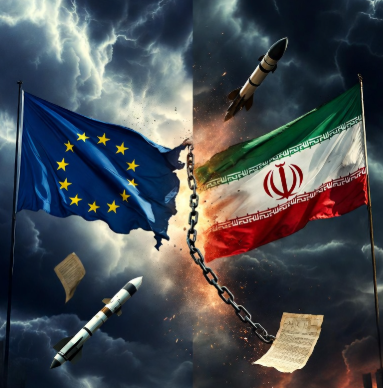

Europe’s response to the war involving the United States, Israel and Iran has sparked debate about the continent’s role in global affairs, with critics arguing that many governments have avoided taking a clear position on the conflict’s legality.
While some European leaders have acknowledged concerns about the legal basis for the military action, most have stopped short of openly condemning the strikes. The cautious reaction contrasts with Europe’s response to earlier conflicts in the Middle East, particularly the US-led invasion of Iraq in 2003.
A divided Europe in 2003
The Iraq war created one of the deepest divisions in Europe in recent decades. France and Germany strongly opposed the invasion and attempted to block it through the United Nations Security Council, arguing that it violated international law.
Other governments, including those of the United Kingdom, Italy and Spain, supported the United States and participated in the military campaign.
The dispute also highlighted tensions between established Western European powers and countries in central and eastern Europe that had recently emerged from Soviet influence. Many of those states backed the United States, seeing Washington as an important security partner.
The disagreement led to sharp political exchanges across the continent and between Europe and the United States.
A catalyst for European diplomacy
Despite the divisions, the Iraq crisis also triggered reflection about Europe’s role in international politics.
Large protests took place across European cities against the war, and many political thinkers argued that Europe should define itself through support for multilateral institutions, international law and diplomatic solutions to global conflicts.
The debate contributed to the development of new diplomatic efforts aimed at addressing tensions over Iran’s nuclear programme.
France, Germany and the United Kingdom formed the core of a negotiating group later expanded to include the European Union, the United States, Russia and China. The talks eventually resulted in the 2015 Joint Comprehensive Plan of Action, known as the Iran nuclear deal.
That agreement limited Iran’s nuclear activities in exchange for sanctions relief and was widely viewed as one of Europe’s most significant diplomatic achievements.
A more restrained response today
In the current conflict involving Iran, the United States and Israel, European governments appear less divided but also less vocal.
Some leaders have acknowledged that the strikes on Iran may raise questions under international law because there was no clear evidence of an imminent threat.
However, few governments have issued direct criticism of Washington or Tel Aviv.
Spain’s Prime Minister Pedro Sánchez has been among the most outspoken critics, condemning the war and refusing to allow certain military bases in Spain to be used in support of the operation. Slovenia and Norway have also expressed opposition.
Most other European leaders have taken a more cautious approach, emphasising diplomacy and regional stability rather than focusing on the legal status of the military campaign.
Leaders emphasise pragmatism
Several senior European figures have suggested that legal arguments should not dominate the discussion about the conflict.
Italian Prime Minister Giorgia Meloni told parliament that the war could be considered a violation of international law but said she neither condemned nor supported the action.
Germany’s Chancellor Friedrich Merz also questioned whether international law provided a useful framework for judging the situation, arguing that allies should avoid publicly criticising each other during a crisis.
European Commission President Ursula von der Leyen said in a speech to EU ambassadors that the debate over whether the conflict was legally justified might miss the broader geopolitical context.
Her remarks prompted European Council President António Costa to reaffirm that the European Union remained committed to international law and multilateral cooperation.
Questions about Europe’s role
The differing responses have reignited debate over Europe’s identity and influence on the world stage.
The European Union has often presented itself as a defender of international law, diplomacy and rules-based cooperation. Critics argue that failing to take a consistent stance in major conflicts could weaken that image.
At the same time, the United States has urged allies to support efforts to secure shipping routes through the Strait of Hormuz, raising questions about whether European governments will become more directly involved in the conflict.
Observers say the way Europe responds to the crisis could shape perceptions of its independence and its capacity to act collectively in international affairs.
As tensions continue in the Middle East, the debate over how Europe balances alliances with its stated principles is likely to remain a central issue for policymakers across the continent.
Join the discussion? 
Already a member? 
 Adapted by ASEAN Now · Source · 15.March 2026