




When the United States and Israel launched strikes on Iran, Beijing did not react immediately. Several hours later, China’s Foreign Ministry said it was “highly concerned,” called for an immediate halt to military operations and urged a return to dialogue. The following day, Foreign Minister Wang Yi condemned the attacks as unacceptable.
The response was firm in tone but limited in substance — a pattern that reflects China’s broader foreign policy approach. Despite its expanding global footprint, Beijing has again chosen to stay on the sidelines militarily while positioning itself as a critic of force and a supporter of negotiations.
Get the latest headlines in your email 
Strategic restraint over intervention
China’s armed forces have modernized rapidly in recent years. It has held joint military drills with Iran and established its first overseas naval base in Djibouti in 2017. Yet its primary security focus remains much closer to home, from Taiwan to the South China Sea.
Beijing has occasionally stepped into Middle East diplomacy when it sees opportunity. In 2023, it helped broker a rapprochement between Iran and Saudi Arabia, a move widely seen as a sign of growing Chinese influence. But analysts say Beijing views U.S. military campaigns in Afghanistan and Iraq as cautionary examples of overreach.
William Yang of the International Crisis Group said China is reluctant to project military power far beyond its immediate periphery or act as a security guarantor in volatile regions like the Middle East.
Similarly, China has offered diplomatic and economic backing to Russia and Venezuela while avoiding direct military involvement in Ukraine or Latin America. Craig Singleton of the Foundation for Defense of Democracies described Beijing’s response to the Iran strikes as “predictably restrained,” underscoring the limits of its influence once hard power is in motion.
U.S. ties take priority over Iran
China’s measured stance also reflects the relative importance it assigns to its relationships. While Beijing maintains strong economic ties with Tehran, its relationship with Washington carries far greater weight, particularly on trade, technology and Taiwan.
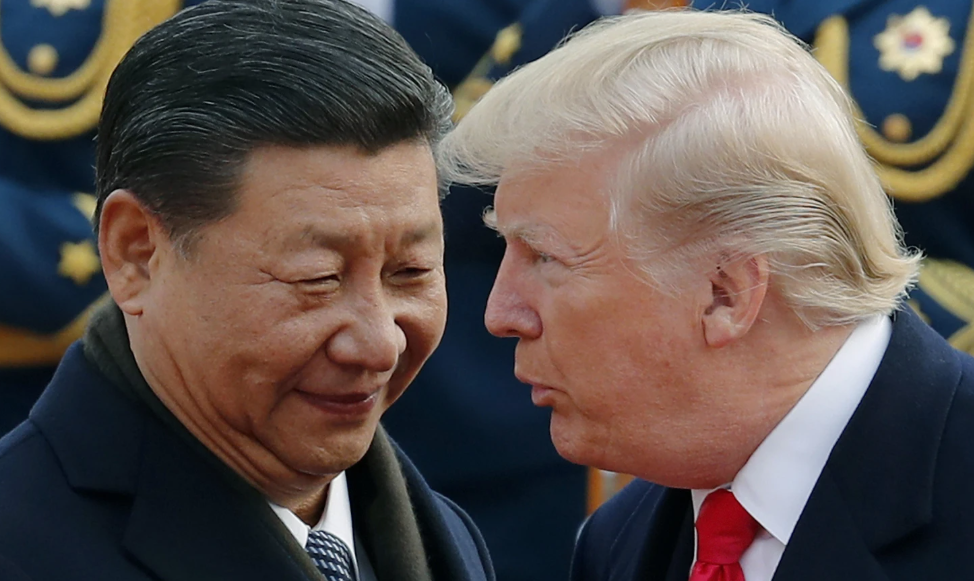
A highly anticipated visit by Donald Trump to Beijing to meet Chinese leader Xi Jinping is expected in the coming weeks. Analysts say Beijing is unlikely to jeopardize that summit over Iran.
George Chen of The Asia Group said that while China may engage in rhetorical sparring with Washington, it has little incentive to escalate tensions. “U.S.-China relations are already complicated enough,” he said, adding that introducing another major flashpoint would benefit neither side.
Energy security and regional risks
China is the largest importer of Iranian oil, taking in roughly 1.4 million barrels per day last year — about 13% of its total seaborne crude imports, according to data from Kpler. However, analysts say Beijing has prepared for potential disruptions by diversifying supply sources and building strategic reserves.
The more pressing concern is not necessarily Iranian oil itself, but instability in the broader Gulf region. Any sustained disruption to shipping through the Strait of Hormuz — a key chokepoint for global oil and liquefied natural gas — would have far-reaching consequences for China’s energy security and economic stability.
Attacks on Gulf energy infrastructure, including liquefied natural gas facilities, add to those worries.
Unlikely to arm Tehran
Despite long-standing defense ties, experts say China is unlikely to provide significant military assistance to Iran. Muhammad Zulfikar Rakhmat of Indonesia’s Center of Economic and Law Studies said any support would likely be limited to existing defense arrangements rather than rapid battlefield aid.
Beijing has repeatedly criticized the United States for supplying weapons to Ukraine, arguing that doing so prolongs conflicts. Providing arms to Iran would risk direct confrontation with Washington and undermine China’s carefully calibrated neutrality.
James M. Dorsey of Nanyang Technological University noted that while Iran’s missile program has roots in Chinese technology, Beijing is likely to err on the side of caution rather than expand support.
Ultimately, analysts say China’s response reveals a foreign policy guided less by ideological alignment and more by pragmatic calculation. Beijing appears determined to avoid entanglement in a distant war while safeguarding its economic interests and preserving space for diplomacy.
Join the discussion? 
Already a member? 
 Adapted by ASEAN Now · Source · 04.03 2026
-
 1
1
-
 1
1