



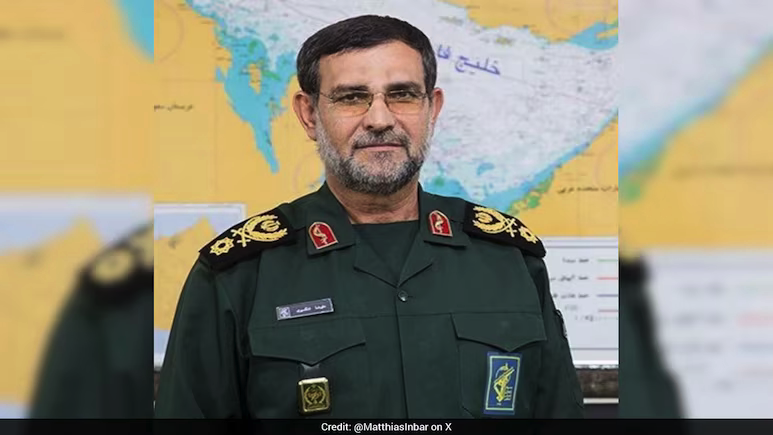

Israel says a strike has killed a senior Iranian naval commander responsible for operations linked to the blockade of the Strait of Hormuz, according to Israeli media citing an Israeli official.
Get today's headlines by email 
The commander, Alireza Tangsiri, headed the naval arm of the Islamic Revolutionary Guard Corps and had overseen activities connected to Iran’s restrictions on shipping through the strategic waterway.
Strike targets senior naval commander
Reports say Tangsiri was killed in a US-Israeli strike in the coastal area of Bandar Abbas. Iranian authorities and the Israeli military had not publicly confirmed the strike at the time of reporting.
If verified, the killing would mark another high-profile casualty in the conflict involving the United States, Israel and Iran, which is now in its fourth week.
Tangsiri had served as IRGC naval commander since 2018 and was regarded as one of the senior Iranian figures who had avoided earlier assassination attempts during the conflict.
Strait of Hormuz shipping collapse
Iran has tightened control over the Strait of Hormuz, a narrow shipping corridor linking the Persian Gulf to global markets. In normal conditions, about one-fifth of the world’s traded oil and gas passes through the waterway.
Since the start of the conflict, Tehran has blocked many vessels it considers linked to the United States or Israel while allowing limited traffic from other countries.
Shipping data indicates a steep drop in energy transport through the channel. Daily cargo movements have fallen roughly 95 percent compared with typical traffic levels.
Industry monitoring group Kpler recorded only 155 commodity carrier crossings between March 1 and March 25, far below the usual rate of about 120 transits per day tracked by shipping intelligence site Lloyd’s List.
Most of the crossings involved oil tankers or gas carriers travelling eastward out of the strait. On Wednesday, analysts detected only two ships passing through, both heading west.
Iranian media outlets close to the Revolutionary Guards have also reported plans to formalize payments for ships allowed to pass. Some vessels are said to have paid fees in Chinese yuan under what analysts describe as an informal toll system.
Leadership losses and political structure
Iran has suffered multiple leadership losses since the war began on February 28. Several senior commanders from the Revolutionary Guards and other top figures have been killed in US-Israeli strikes.
Among them was Ali Larijani, a longtime adviser to Iran’s leadership whose death earlier in the conflict was seen as a major blow due to his influence across political institutions and his experience dealing with foreign powers.
Despite the deaths of several prominent figures, analysts say Iran’s political system has continued to function. The structure combines clerical leadership with elected institutions, including a president and parliament, and multiple centers of authority within the security establishment.
Formed after the Iranian Revolution, the Islamic Republic’s governing model distributes power across various bodies rather than concentrating it in a single leadership circle.
Officials and analysts say this layered system has helped Iran maintain operational capacity during the conflict.
At the same time, the removal of more pragmatic figures could strengthen hardline factions within the leadership, potentially influencing Iran’s approach to the ongoing war and relations with foreign powers.
oin the discussion? 
Already a member? 
 Adapted by ASEAN Now. Source 26 March 2026