



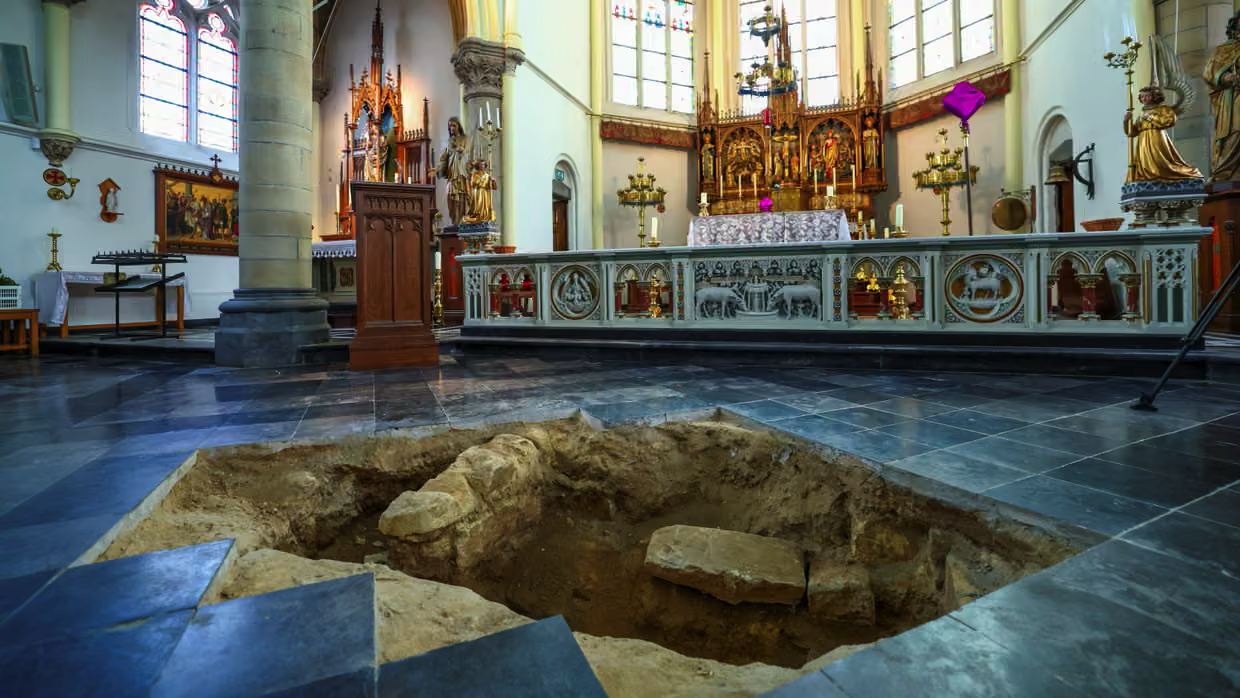

Archaeologists in the Dutch city of Maastricht are investigating whether a skeleton discovered beneath a church floor could belong to the 17th-century soldier believed to have inspired the hero of The Three Musketeers.
Get today's headlines by email 
Workers uncovered the remains while repairing damage at the Church of St Peter and St Paul in the city’s Wolder district. The discovery was made after part of the church floor collapsed, exposing a burial site beneath the altar.
Skeleton Discovered During Church Repairs
Local officials contacted retired archaeologist Wim Dijkman, who has spent nearly three decades searching for the burial place of Charles de Batz‑Castelmore d’Artagnan. The Gascon nobleman served as a musketeer and intelligence agent for Louis XIV and died during a battle near Maastricht in 1673.
The long-standing question of where the soldier was buried has remained unresolved for more than three centuries.
Clues Found in the Grave
Church officials say several details surrounding the burial align with historical accounts of d’Artagnan’s death and funeral.
According to Deacon Jos Valke, the remains were located in consecrated ground beneath the altar. A coin dating to the same period was also discovered in the grave.
Perhaps the most striking detail was the presence of a bullet near the skeleton’s chest. Historical records describe d’Artagnan being killed by a musket shot to the throat during the 1673 siege of Maastricht.
These elements have led archaeologists to consider the possibility that the remains could belong to the famed musketeer. Still, researchers say confirmation requires scientific testing.
The skeleton has since been transferred to an archaeological institute in the Dutch city of Deventer for further study.
DNA Tests Under Way
Scientists collected a DNA sample from the remains on 13 March and sent it to a laboratory in Munich for analysis.
The genetic material will be compared with DNA provided by descendants of d’Artagnan’s father. Researchers hope the comparison will determine whether the skeleton belongs to the historical figure.
Dijkman said investigators are approaching the discovery cautiously despite the excitement surrounding it. Multiple examinations and analyses are under way in the Netherlands and abroad as experts attempt to verify the identity of the remains.
The case has drawn attention beyond Maastricht due to d’Artagnan’s enduring reputation.
From Soldier to Literary Legend
The real-life musketeer became widely known after Alexandre Dumas published The Three Musketeers in 1844. The novel turned d’Artagnan into a central character in a story about loyalty, adventure and court intrigue.
Dumas drew inspiration from an earlier work, Mémoires de M. d’Artagnan, written in 1700 by the French author and soldier Gatien de Courtilz de Sandras.
The fictional version of d’Artagnan has appeared in numerous film and television adaptations over the past century. The character has also been reimagined in popular culture, including as the sword-wielding dog hero of the animated series Dogtanian and the Three Muskehounds.
If the newly discovered remains are confirmed to be his, the find would resolve a historical mystery dating back more than 350 years.
Join the discussion? 
Already a member? 
 Adapted by ASEAN Now. Source 26 March 2026