



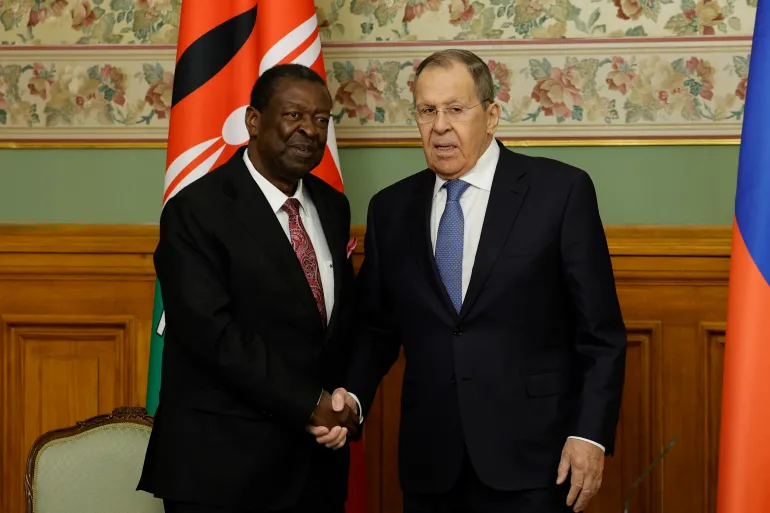

Musalia Mudavadi has said Russia has agreed to stop recruiting Kenyan nationals to fight in the war in Ukraine, following talks held in Moscow with his Russian counterpart Sergei Lavrov.
Get today's headlines by email 
Speaking alongside Lavrov, Kenya’s foreign minister stated that both sides had reached an understanding that Kenyan citizens would no longer be enlisted through Russia’s defence ministry. “They will no longer be eligible to be enlisted,” Mudavadi said.
Lavrov did not directly confirm the agreement but maintained that all foreign fighters serving with Russian forces had joined voluntarily and in accordance with Russian law.
Concerns over recruitment practices
The announcement follows mounting concern in Kenya over reports that large numbers of its citizens had been recruited to fight in the conflict. A Kenyan intelligence assessment in February suggested that more than 1,000 nationals had been enlisted.
Some individuals have claimed they were misled, having travelled to Russia for what they believed were civilian job opportunities, only to be drawn into military service in Ukraine.
Kenyan authorities have responded by targeting suspected recruitment networks. Mudavadi previously said that more than 600 agencies had been shut down after being accused of deceiving job seekers with false promises of employment abroad.
Lawmakers in Nairobi have also raised concerns about possible links between recruitment efforts and human trafficking networks, with allegations that rogue officials may have facilitated the process.
Efforts to bring citizens home
The Kenyan government is now seeking the return of nationals currently involved in the conflict. Mudavadi said 27 Kenyans had already been repatriated, with support provided to help them recover from trauma and undergo rehabilitation.
However, the total number of Kenyans still in Russia or Ukraine remains unclear, and there is limited information on casualties. Families searching for missing relatives have reported difficulties obtaining answers from Russian authorities.
Public concern has intensified in recent months. In February, relatives of those believed to be fighting in Ukraine staged a protest outside parliament in Nairobi, calling for government intervention and the safe return of their loved ones.
Broader diplomatic ties
During his visit to Moscow, Mudavadi is also expected to pursue discussions on expanding employment opportunities for Kenyans in Russia, separate from military involvement.
He emphasised that relations between Kenya and Russia should not be defined solely by the conflict in Ukraine, describing the partnership as broader in scope.
According to Ukrainian intelligence estimates, more than 1,700 individuals from 36 African countries have been recruited to fight for Russia. Other nations have also taken action: South Africa recently repatriated 17 citizens who said they had been misled into joining the conflict.
Ukraine has faced criticism as well over efforts to recruit foreign fighters, including from African countries, to support its own war effort.
Join the discussion? 
Already a member? 
 Adapted by ASEAN Now. Source 17 March 2026