
Skip to content
View in the app

A better way to browse. Learn more.

ASEAN NOW

A full-screen app on your home screen with push notifications, badges and more.

To install this app on iOS and iPadOS
  1. Tap the Share icon in Safari
  2. Scroll the menu and tap Add to Home Screen.
  3. Tap Add in the top-right corner.
To install this app on Android
  1. Tap the 3-dot menu (⋮) in the top-right corner of the browser.
  2. Tap Add to Home screen or Install app.
  3. Confirm by tapping Install.

Thailand or Vietnam: Retirement choices

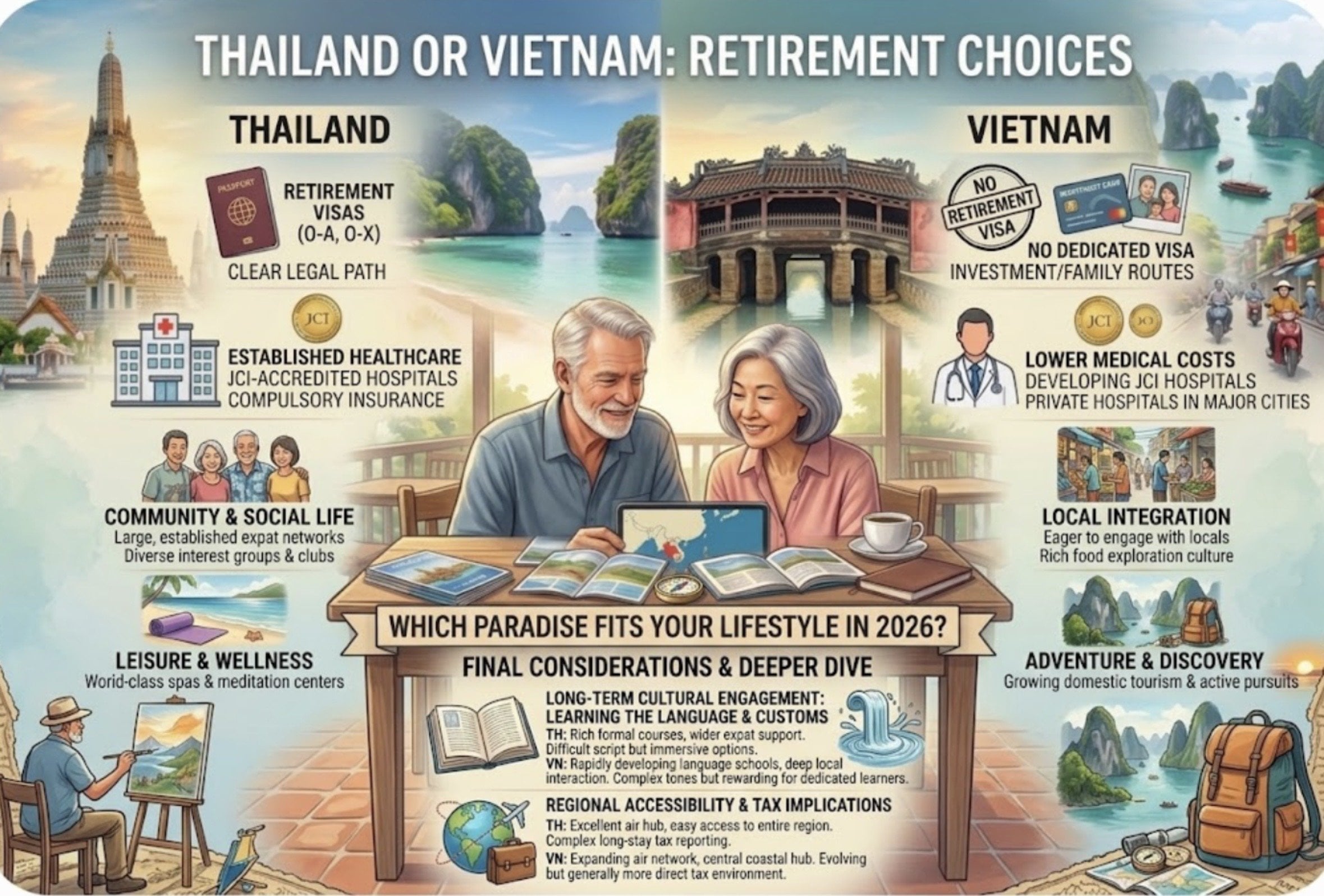
Thailand offers foreign retirees a clearer legal route to long-term residence than Vietnam, but Vietnam can cost considerably less for those able to manage more complicated visa arrangements. For people deciding where to spend retirement in Southeast Asia, the choice in 2026 often comes down to predictable paperwork and healthcare versus lower rent and daily spending.

Thailand has developed visa options specifically for retirement. The Non-Immigrant O visa allows foreigners aged 50 and above to stay for one or more years, when renewed, for retirement purposes.

Applicants generally need a valid passport, basic medical certificate and depending on initial visa, Thai-recognised health insurance. They must also show either 800,000 baht in a Thai bank account or a monthly income of 65,000 baht.

Vietnam has no retirement visa

Vietnam does not have a dedicated retirement visa, nor a visa category based only on a person's age, pension income or retirement status. Retirees seeking a long stay must instead pursue a Temporary Residence Card through eligible work, investment or family-tie routes, or use investment and family-reunion visas.

That can involve more legal complexity than a retirement move to Thailand. Investment-linked residence may require a compliant local company, along with continuing tax filings and audits, obligations that may not suit someone who has stopped working.

For foreigners who want an established route without relying on a job, investment or family sponsorship, Thailand's retirement visa framework is therefore a major practical advantage. Conditions, including financial evidence and insurance, should nevertheless be checked before applying.

Vietnam's advantage is everyday cost

Comparisons cited by Travelbinger put Vietnam around 20-30% cheaper than Thailand for a similar expat lifestyle. Rent is estimated to be roughly 40% lower on average.

Modern one-bedroom apartments are quoted at US$300-500 in Ho Chi Minh City and US$200-350 in Da Nang. Comparable rents are put at US$400-700 in Bangkok and US$350-550 in Chiang Mai.

A comfortable retirement budget is estimated at US$800-1,200 a month in Vietnam, compared with US$1,200-1,800 in Thailand. Annual estimates put comfortable expat spending at US$22,000-30,000 in Vietnam, against US$30,000-40,000 in Bangkok.

Street-food meals are estimated at US$1-3 in Vietnam and US$2-4 in Thailand, while restaurant dinners are US$5-12 and US$8-15 respectively. Domestic beer is also said to be cheaper in Vietnam.

The gap can narrow for retirees dependent on imported food and Western amenities, which can be significantly more expensive in Vietnam. Those happy with local food are likely to see the largest savings.

Healthcare, property and daily life

Thailand's established medical-tourism sector attracts more than two million medical tourists each year, including visitors from the United States, Australia, the Middle East and Europe. Its private hospital network includes JCI-accredited facilities, English-speaking staff and short waiting times.

Vietnam does not require health insurance for any visa category. Government figures put Vietnamese medical services at about 30-50% of the cost in Singapore or Thailand, but the country currently has four JCI-accredited hospitals. The health ministry aims for at least 15 internationally standard hospitals by 2030, including five public hospitals; retirees currently rely heavily on private hospitals in Hanoi and Ho Chi Minh City.

Neither country lets foreigners buy land outright. Vietnam permits foreign apartment purchases on 50-year leasehold terms, while Thailand has condominium ownership rules for foreigners and an established rental market.

Thailand has also applied tax rules since 2024 to foreign-source income brought into the country in the year it is earned. Retirees moving money to Thailand may need advice on tax exposure and their home country's double-taxation treaty.

Thailand offers more established expat infrastructure, English signage, public transport and retirement services. Vietnam offers lower costs, but busier traffic, less consistent English outside major cities and a more energetic pace. For many retirees, the decision is whether those savings outweigh Thailand's clearer long-term setup.

Join the discussion? Create account. orange.png


image.png

18 August 2026

User Feedback

Recommended Comments

Yellowtail Star Member

Yellowtail

Advanced Member
(edited)

It is worth noting, that (I think) the financial requirements came about in large part because too many people were lying on the income affidavits.

Edited by Yellowtail

SamSpade Silver Member

SamSpade

Advanced Member
1 hour ago, KhunHeineken said:

Interesting.

So, they may have pegged it to the USD. I had not considered that.

I had to Google the date but up until July 1997 THB was fixed to USD so whichever way USD moved the THB FX rate stayed constant...

The Thai Baht was decoupled from the US dollar on July 2, 1997. The Bank of Thailand abandoned the fixed peg system and allowed the currency to float, which triggered the 1997 Asian Financial Crisis. [1, 2]

Background and Events

  • The Peg: Thailand had maintained a fixed exchange rate, or near-peg, to the US dollar since the mid-1950s.

  • The Pressure: Heavy speculative attacks and draining foreign reserves forced the change.

  • The Result: The Baht lost significant value rapidly, setting off an economic chain reaction across Southeast Asia. [1, 2, 3, 4, 5]

KhunHeineken Diamond Member

KhunHeineken

Advanced Member
17 minutes ago, Jingthing said:

With the bank method, if that's what the Thai government thinks people will use for emergencies, if they do, that makers their status instantly illegal.

Whether bank method or not people should have a separate liquid emergency fund. How much? It would be a can of worms to be specific.

Medical insurance helps to manage risk.

Jingthing Legendary Member

Jingthing

Advanced Member
(edited)
8 minutes ago, KhunHeineken said:

Medical insurance helps to manage risk.

In theory.

In reality it very often doesn't.

Too expensive or hard to get in old age / with conditions.

If you can get it and afford it, there are often exclusions for what you need it for the most.

Depending on plan, often need to shell out the money first and then make a claim whuch may or may not be paid.

If you're using your 800K baht to shell out, you're then in violation of your visa status.

Edited by Jingthing

Yellowtail Star Member

Yellowtail

Advanced Member
56 minutes ago, KhunHeineken said:

Medical insurance helps to manage risk.

But it costs more, and is much more difficult to verify than B800K in the bank.

KhunHeineken Diamond Member

KhunHeineken

Advanced Member
2 minutes ago, Yellowtail said:

But it costs more, and is much more difficult to verify than B800K in the bank.

I'm buying a product, not donating money to a Thai bank. Big difference.

Yellowtail Star Member

Yellowtail

Advanced Member
9 minutes ago, KhunHeineken said:

I'm buying a product, not donating money to a Thai bank. Big difference.

Is it not possible to have a discussion without telling the same lies over and over?

Decent medical insurance would likely cost me at least $1,000 a month, if I could get it, or about B800K in two years.

Do you think the insurance company will give my $24K back after two years? The bank will.

KhunLA Star Member

KhunLA

Advanced Member
(edited)
4 hours ago, Yellowtail said:

Do you think the insurance company will give my $24K back after two years? The bank will.

BINGO, we have a winner ...

Unless you're in a state of constant bad health, healthcare insurance is a waste of money. Like renting vs owning your home. You have nothing in hand after all those decades of payments.

Insurance is like gambling, you're paying someone, hoping something bad will happen, and they got you thinking scared, that it will happen. That's way too funny.

To obvious to an intelligent person, you're losing the bet. Just like the casino, the odds are stacked way in favor of the insurance company, or neither would exist. Both are billion $$$ profit making businesses every year.

Edited by KhunLA

scubascuba3 Star Member

scubascuba3

Advanced Member
2 hours ago, KhunLA said:

BINGO, we have a winner ...

Unless you're in a state of constant bad health, healthcare insurance is a waste of money. Like renting vs owning your home. You have nothing in hand after all those decades of payments.

Insurance is like gambling, you're paying someone, hoping something bad will happen, and they got you thinking scared, that it will happen. That's way too funny.

To obvious to an intelligent person, you're losing the bet. Just like the casino, the odds are stacked way in favor of the insurance company, or neither would exist. Both are billion $$$ profit making businesses every year.

Having worked at Lloyds of London it was interesting talking to some guys there, they said insurance is about scaring people and with fear they buy insurance

JerryM Gold Member

JerryM

Advanced Member
(edited)
9 hours ago, Yellowtail said:

It is worth noting, that (I think) the financial requirements came about in large part because too many people were lying on the income affidavits.

It also came about because Thai IMM came to the (shocking) realization that the US and other embassies were in no way authenticating that the expat IN FACT had the necessary 65K deposit per month. And the embassies responded when IMM suggested they should so authenticate: Forget about it.

But as long as I'm here, Thai law in general provides that there cannot be only one way (i.e. 800k bank deposit) to meet a requirement so that the ministerial regulation provided a secondary way to meet the requirement i.e. the 65 K per month deposit. That is, a secondary option to meet the requirement other than paying a bribe to IMM through a conduit.

Edited by JerryM

sqwakvfr Platinum Member

sqwakvfr

Advanced Member
10 hours ago, Yellowtail said:

You meet people in gyms, and they start talking about their wives' in-laws? What, like in the shower?

I never said that, but yes, I am lucky. "I'd rather be lucky than good", as they say.

Did you ever need and ask for financial help from your relatives?

Quit feeling sorry for yourself, you are very lucky.

Been going to the same Gym for years. After a while you get to know people and have serious conversations. No conversations in the showers because showers are for one person only. Have you ever been to a gym?

Never asked money or much of anything from parents or a relative. The only relative that helped me was "Uncle Sam" You know who that is right? That is if you ever served. Lastly I do not feel sorry for myself. I have built a good life for myself and enjoy retirement with a solid finances. Most importantly I am not beholden to anyone.

NedR69 Silver Member

NedR69

Advanced Member
On 8/18/2026 at 3:59 AM, scubascuba3 said:

Vietnam is only an option if still single, benefit of being single, you can go anywhere

I agree. I'm already vested here, and not wanting to move.

jacko45k Star Member

jacko45k

Advanced Member
(edited)

10 hours ago, Yellowtail said:

11 hours ago, Yellowtail said:

It is worth noting, that (I think) the financial requirements came about in large part because too many people were lying on the income affidav

Pretty sure the 800k hs been around even longer than the Embassy letter. The proof of income/ funds used to be even easier, my neighbours simply got a letter from a financial institution and did not involve any Embassy. The Oz affidavit was often dishonest. They just issued it!

What came later was longer time periods the deposit had to be held in the Thai bank. A bit of a contradiction as the money was supposed to be useable, It also boosted Thailand financially as retirees had to bring in a chink of foreign currency which Thailand needed at the time.

Edited by jacko45k

KhunHeineken Diamond Member

KhunHeineken

Advanced Member
11 hours ago, Yellowtail said:

Is it not possible to have a discussion without telling the same lies over and over?

Decent medical insurance would likely cost me at least $1,000 a month, if I could get it, or about B800K in two years.

Do you think the insurance company will give my $24K back after two years? The bank will.

As I have posted before, I retired younger than most.

I am simply not as old as you, thus insurance is still available to me, and whilst it's a little expensive, it's still affordable. I'm in good health, with no pre existing conditions. Get it?

If / when the day comes where insurance no longer represents value for money, due to my age, I will self insure. With Wise, money can be here in seconds. No need to donate it to a Thai bank. Yeah, I know, rocket science for you.

jacko45k Star Member

jacko45k

Advanced Member
4 minutes ago, KhunHeineken said:

No need to donate it to a Thai bank. Yeah, I know, rocket science for you.

Isn't Wise set to become a Thai bank soon?

KhunHeineken Diamond Member

KhunHeineken

Advanced Member
2 hours ago, jacko45k said:

It also boosted Thailand financially as retirees had to bring in a chink of foreign currency which Thailand needed at the time.

This is why I have raised the topic lately.

The Thai economy is not going so well. It's been decades the 800k / 65k have remained at these amounts. There is a higher cost of living in 2026. Other peripheral things that are more debatable, such as the PM is racist. There's the big crackdown of foreign ownership of property. The use of agents circumvent the immigration laws, similar to using Thai company nominees.

The Thai government can inject capital into Thai banks, at any time, by simply raising the 800k / 65k.

I would not be surprised it's it's still 800k / 65k five years from now, but I also would not be surprised to wake up next week and see they have raised the amounts.

It's not if, just when, and by what amounts. It's the amount of the increase that may be part of a broader policy to tip out those foreigners living here on meager means. If so, the increase will also come with a ban on agents.

As an aside, the visa laws here have got out of control, similar to Thai company nominees for owning land. Basically, there's a visa class that ensures that anyone who wants to live in Thailand can.

KhunHeineken Diamond Member

KhunHeineken

Advanced Member
7 hours ago, KhunLA said:

BINGO, we have a winner ...

Unless you're in a state of constant bad health, healthcare insurance is a waste of money. Like renting vs owning your home. You have nothing in hand after all those decades of payments.

Insurance is like gambling, you're paying someone, hoping something bad will happen, and they got you thinking scared, that it will happen. That's way too funny.

To obvious to an intelligent person, you're losing the bet. Just like the casino, the odds are stacked way in favor of the insurance company, or neither would exist. Both are billion $$$ profit making businesses every year.

Meanwhile, there's an Australian guy in ICU in a hospital in Bangkok who is racking up $50,000 per week.

NanLaew Star Member

NanLaew

Advanced Member
13 hours ago, SamSpade said:

I had to Google the date but up until July 1997 THB was fixed to USD so whichever way USD moved the THB FX rate stayed constant...

The Thai Baht was decoupled from the US dollar on July 2, 1997. The Bank of Thailand abandoned the fixed peg system and allowed the currency to float, which triggered the 1997 Asian Financial Crisis. [1, 2]

Background and Events

  • The Peg: Thailand had maintained a fixed exchange rate, or near-peg, to the US dollar since the mid-1950s.

  • The Pressure: Heavy speculative attacks and draining foreign reserves forced the change.

  • The Result: The Baht lost significant value rapidly, setting off an economic chain reaction across Southeast Asia. [1, 2, 3, 4, 5]

I remember it well. Almost 80 baht to the pound sterling. I even rushed out and bought a Harley-Davidson that I didn't know how to ride.

KhunHeineken Diamond Member

KhunHeineken

Advanced Member
2 hours ago, NedR69 said:

I agree. I'm already vested here, and not wanting to move.

What you want, and what the Thai government may want in the future, are two different things. Unless you have PR or Thai citizenship, you are just on a 1 year tourist visa.

NanLaew Star Member

NanLaew

Advanced Member
27 minutes ago, jacko45k said:

Isn't Wise set to become a Thai bank soon?

Wise is not becoming a bank, but it has received five regulatory licenses from the Bank of Thailand to operate locally as a fully licensed non-bank financial service provider.

K2938 Silver Member

K2938

Advanced Member
On 8/19/2026 at 2:05 AM, scubascuba3 said:

Just stay for less than 6 months, same Thailand or wherever

Not true. Even if you live in VN for less than 6 months and cannot prove tax residency elsewhere, you will be considered tax resident

scubascuba3 Star Member

scubascuba3

Advanced Member
6 minutes ago, K2938 said:

Not true. Even if you live in VN for less than 6 months and cannot prove tax residency elsewhere, you will be considered tax resident

I'm tax resident in UK, but unlikely they will chase down guys on tourist visas staying for a few months

Yellowtail Star Member

Yellowtail

Advanced Member
50 minutes ago, KhunHeineken said:

Meanwhile, there's an Australian guy in ICU in a hospital in Bangkok who is racking up $50,000 per week

What happened to him?

BritManToo Star Member

BritManToo

Advanced Member
14 hours ago, KhunHeineken said:

Medical insurance helps to manage risk.

Only if you're too proud or stupid to use government hospitals.

BritManToo Star Member

BritManToo

Advanced Member
54 minutes ago, KhunHeineken said:

Meanwhile, there's an Australian guy in ICU in a hospital in Bangkok who is racking up $50,000 per week.

His own fault for using a private hospital.

KhunHeineken Diamond Member

KhunHeineken

Advanced Member
4 minutes ago, BritManToo said:

His own fault for using a private hospital.

If you're unconscious, I doubt you get to chose. 🙂

KhunLA Star Member

KhunLA

Advanced Member
(edited)
3 minutes ago, BritManToo said:

His own fault for using a private hospital.

And riding a MB, uninsured, inexperienced & helmet ?

News blip doesn't offer much info, and KH omitted the fact he 'supposedly' had multiple brain surgeries. And 500k for flight home ... on a private jet w/med staff ... WTF.

Edited by KhunLA

NedR69 Silver Member

NedR69

Advanced Member
2 hours ago, KhunHeineken said:

What you want, and what the Thai government may want in the future, are two different things. Unless you have PR or Thai citizenship, you are just on a 1 year tourist visa.

Yes, and it could be even worse than only having a 1 yr permission to stay. I think I read in news today Thailand could go further, such as limiting specific countries and some even based on countries economy.

KhunHeineken Diamond Member

KhunHeineken

Advanced Member
(edited)
1 hour ago, KhunLA said:

And riding a MB, uninsured, inexperienced & helmet ?

Must have been riding around in his hotel room.

https://www.dailymail.com/tvshowbiz/article-16068643/casey-james-thailand-accident-father-coma-warren-ginsberg.html

"He was found alone in his hotel room, unconscious, after suffering a serious fall following a sudden brain bleed."

1 hour ago, KhunLA said:

KH omitted the fact he 'supposedly' had multiple brain surgeries. And 500k for flight home ... on a private jet w/med staff ... WTF.

It's called a medical evacuation back to one's home country for public hospital system treatment, and to be surrounded by friends and family.

Medevacs are not cheap.

From AI.

"A medical evacuation (medevac) flight typically costs anywhere from $5,000 to over $300,000 depending on the distance, aircraft type, and medical care required.

Cost Breakdown by Transport Type

  • Helicopter missions: Range from $10,000 to $40,000+ per trip, often used for regional or rugged rescues.

  • Domestic fixed-wing flights: Range from $5,000 to $25,000+ depending on the distance and required staff.

  • International or long-haul flights: Often exceed $100,000 and can reach up to $300,000+ (such as an evacuation from Bali to Australia costing $40,000–$90,000, or Europe to Australia exceeding $150,000).

Main Cost Factors

  • Distance and route: Longer flights require more fuel, specialized crew rotations, and cross-border landing permits.

  • Medical staffing: On-board specialized doctors, flight nurses, or critical care paramedics increase the price.

  • Equipment level: Life-support systems, specialized monitors, and ventilators add to the operational cost.

  • Logistics: Bed-to-bed coordination, including ground ambulance transfers at both ends, affect the total bill."

Edited by KhunHeineken

Create an account or sign in to comment

Account

Navigation

Search

Search

Configure browser push notifications

Chrome (Android)
  1. Tap the lock icon next to the address bar.
  2. Tap Permissions → Notifications.
  3. Adjust your preference.
Chrome (Desktop)
  1. Click the padlock icon in the address bar.
  2. Select Site settings.
  3. Find Notifications and adjust your preference.