



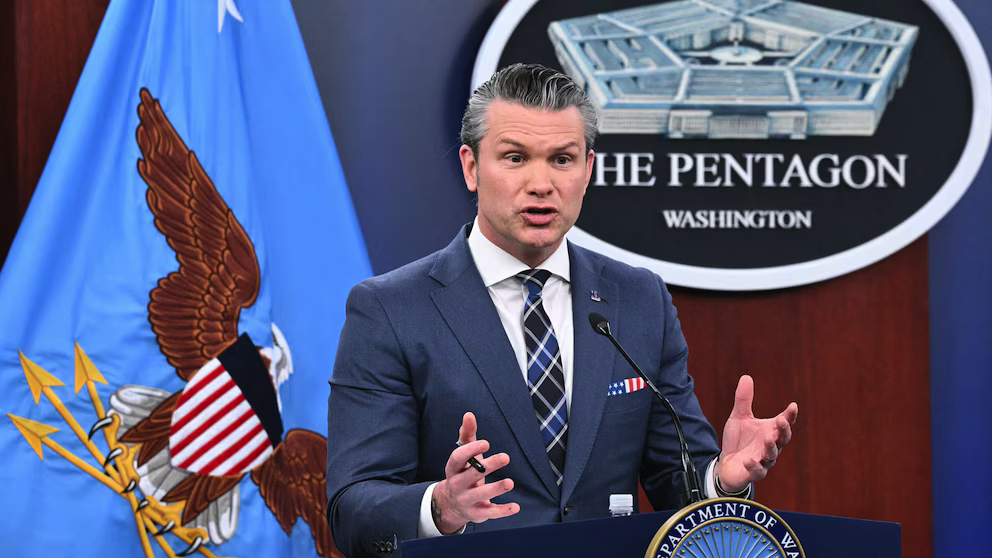

The United States defence secretary has said there is no fixed timetable for ending the ongoing war with Iran, as fighting continues to escalate across the region and tensions remain high. Speaking to reporters, Pete Hegseth said it would be up to Donald Trump to determine when military operations conclude.
Get today's headlines by email 
“We wouldn’t want to set a definitive time frame,” Hegseth said, adding that the campaign remained “on track” and that any decision to halt operations would depend on whether US objectives had been achieved.
No timeline set for conflict
The conflict, now entering its third week, began with coordinated US and Israeli strikes on Iranian targets and has since expanded into a broader regional confrontation.
The latest developments follow a sharp escalation involving attacks on key energy infrastructure. Iran launched missiles at facilities in Qatar after strikes targeted the South Pars gas field, the world’s largest gas reserve.
The Qatari site at Ras Laffan, one of the largest liquefied natural gas export hubs, was reported to have sustained significant damage.
These incidents have contributed to rising global energy prices, with oil markets reacting sharply amid fears of supply disruption.
Ongoing military exchanges
Air strikes and missile attacks have continued across multiple fronts, including Iran, Israel and parts of the wider Middle East.
Casualty figures have risen steadily, with deaths reported in Iran, Lebanon, Israel and Gulf states, as well as among US forces.
Hegseth said Iranian naval capabilities had been significantly weakened, claiming the country’s surface fleet was no longer operational and that its small submarine force had been eliminated. These vessels are typically designed for operations in shallow waters such as the Strait of Hormuz.
His comments echoed earlier statements from President Trump, who said Iran’s military had been “obliterated”, though no detailed evidence was provided.
Communication challenges inside Iran
Efforts to assess the situation within Iran have been complicated by an ongoing internet blackout imposed by authorities in Tehran.
The disruption has limited communication from within the country, making it difficult to independently verify conditions on the ground or gauge public response to the conflict.
Meanwhile, US officials said they were continuing efforts to communicate with different audiences inside Iran, though no further details were given.
Regional and global implications
The conflict has drawn condemnation from countries across the Gulf, with regional leaders warning that attacks on energy infrastructure risk further destabilising global markets.
As fighting continues without a clear end point, uncertainty remains over how long the conflict may last and what conditions would lead to a ceasefire.
Join the discussion? 
Already a member? 
 Adapted by ASEAN Now. Source 19 March 2026