



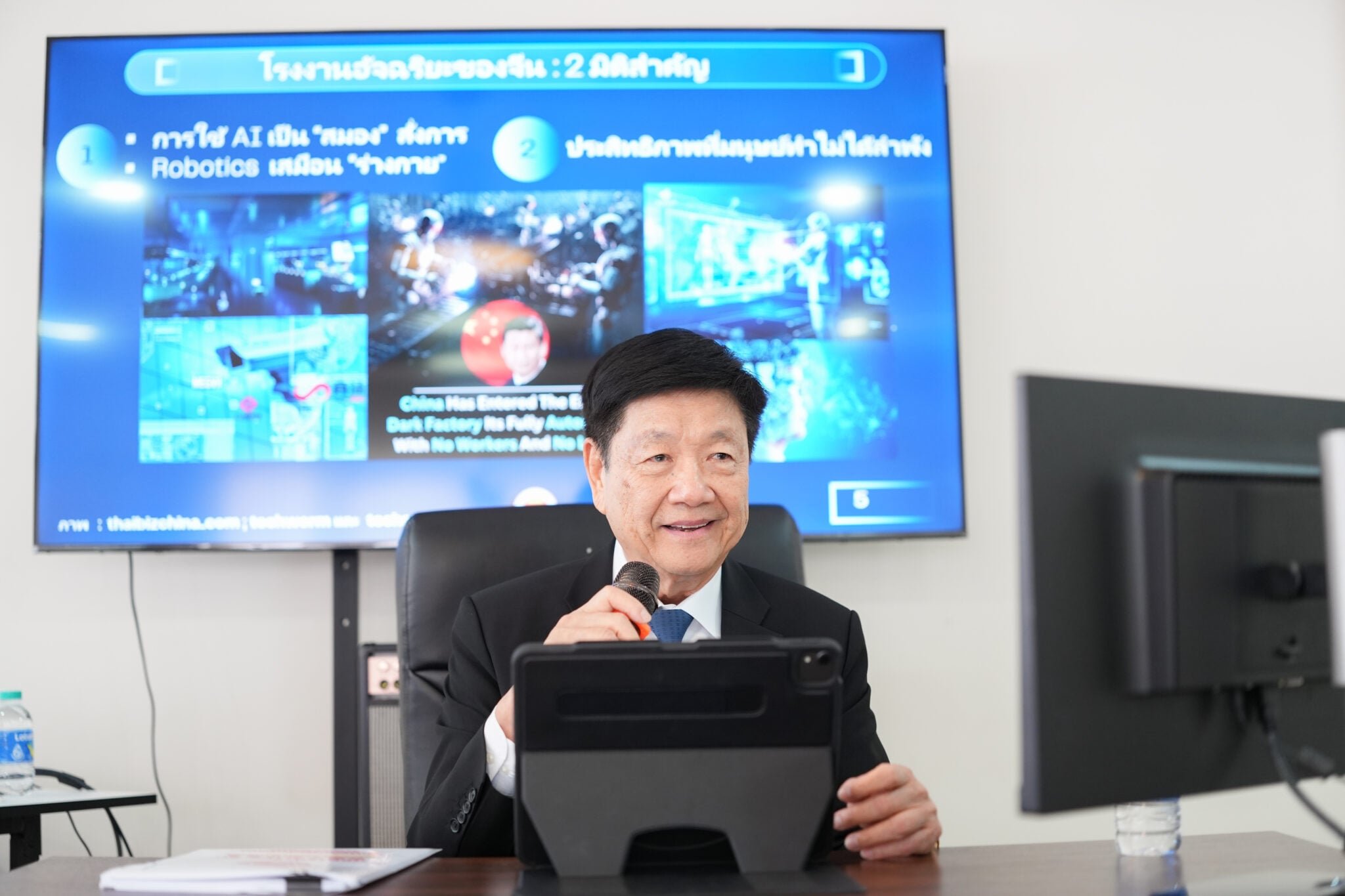

The president of the Thai–Chinese Chamber of Commerce has called on Thai business leaders to urgently adapt to China’s rapid advances in artificial intelligence-driven manufacturing, warning that global competition is being reshaped by “intelligent production” systems. The remarks were delivered during a special lecture aimed at strengthening the capabilities of a new generation of Thai–Chinese executives.
The lecture took place on Saturday, 31 January 2026, as part of the Young Executive Program 3 for the academic year 2026. The programme was organised by the Thai–Chinese Journalists Association and the Thai–Chinese Media and Business Administration Institute, with official support from the Chinese Embassy in Thailand, the Thai–Chinese Chamber of Commerce and China Media Group.
Dr Narongchai Phutthaprommongkol, president of the Thai–Chinese Chamber of Commerce, spoke at the M Group Building on Vibhavadi Rangsit Road in Bangkok. More than 60 executives attended the session, which focused on the theme “Decoding Intelligent Production: Transforming Chinese Industry with AI”, and were welcomed by Mr Sun Guangyong, secretary-general of the association on the Chinese side.

Dr Narongchai said China has undergone a major transformation over the past seven years, shifting from a low-cost manufacturing base to a leader in what it terms “new productive forces”. Under China’s 15th National Economic and Social Development Plan (2026–2030), the country is prioritising the smartest and highest-quality production to address demographic challenges and labour costs that have risen four- to five-fold.
He explained that combining AI with robotics creates systems with both “a brain and a body”, capable of autonomous decision-making, high precision and continuous 24-hour operation. Examples cited included the Qingdao smart port, the world’s first fully automated port using 5G and real-time AI, and ports in Guangxi such as Qinzhou, which serve as logistics hubs for the Belt and Road Initiative.
Further examples included Beihai Port, where conveyor systems move raw materials directly from ships to factories, enabling throughput of up to 70,000 tonnes per day. In manufacturing, Dr Narongchai highlighted smart factories operated by Xiaomi and automotive brands such as Hongqi and FAW, which can produce one vehicle every five to seven minutes using near-total automation.
On Thailand’s position, he said the influx of Chinese goods, often described as the China dumping effect, presents both risks and opportunities. He urged Thai firms to shift from price competition to value creation, treat China as a strategic partner, and pursue investment linked to technology transfer and high-tech local content, similar to Thailand’s past cooperation with Japan.
Daily News reported that Dr Narongchai concluded that AI should not be feared if used effectively, noting that smart factories will still require highly skilled human workers. He stressed the need to upskill Thai labour, particularly in the Eastern Economic Corridor, where tens of thousands of positions remain vacant and called for strategic cooperation to sustainably upgrade Thai industry.

Pictures courtesy of Daily News

Key Takeaways
• China is repositioning itself as a global leader in AI-driven intelligent manufacturing under its 2026–2030 national plan.
• Smart ports and automated factories in China demonstrate major gains in speed, efficiency and supply chain integration.
• Thailand is urged to pursue technology transfer, workforce upskilling and strategic partnership with Chinese investors.

Adapted by ASEAN Now from Dailynews 2026-02-04

