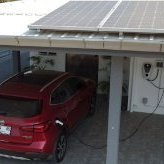
May 22May 22 Popular Post 22 minutes ago, carlyai said:As it currently stands 3 phase export is limited to 10kW and single phase 5kW, as per the government announcement.Thanks for clarifying, I was confused and wondering if the PEA regulation changed... how in heavens can you export 20kW? I wanted too!!! hahaAll 3-phase inverters output a balanced 3-phase AC by design, it distributes generation roughly equally across all three phases (~3.33kW each for a 10kW system).PEA's grid code requires load balancing for 3-phase inverters.Wife Booked her new IM5 today, in Red! I got free 3M Crystaline film, but the sales told they dont put film on the sunroof and gave some excuses. I checked with Gemini and it's actually an interesting topic to discuss.First, high grade films reflect the UV and radiation, medium grade (but still excellent films) use absorbs the UV and radiation generating a lot of heat on the glass. You must not ever install absorbing films because of gradient overheating and heat differential can explode the glass. Installing reflective films are the only way to go, but Gemini didnt recommend the darkest one for the sunroof like CR20, it recommend CR40 to prevent excessive heating of the sun roof. I didnt verify with with other LLMs but I will later.so I will have the sun roof without film first, and let's see how it goes.
May 23May 23 Popular Post A good amount of stats in this car250.com 23 May 2026 article....even talks the recent Volvo fires in Thailand. The article is in depth and kinda long compared to the typical car250.com article. See weblink below for full article.https://www.car250.com/hybrid-phev-bev-2024-2025.html
May 23May 23 4 hours ago, Bandersnatch said:Couple of random Battery GraphicsThe comparison is good and really useful for people new to EV.However it doesn't take into consideration many more facts that affect battery Longevity, and might not be always true for new NMC batteries.An NMC battery on a car with good cooling system, and rated for high DC fast charge will certainly outlast an LFP battery with poor cooling system and charging at the 100% rate. i.e. the Atto 3, max is 88kW, and you charge 88kW until 65%, vs a car with 320kW and you charge at 120kW, is a big difference.another factor is that NMC has various typesWhat really matters is thermal stability, regardless of NMC or LFP, it's the heat and thermal expansion and contraction that kills batteries. This is why we will be upgrading from Atto 3 at 89% SOH, to the MG IM5, I choose this car for my wife because it's the only from the very few TRUE 800V platform (875V), I didnt want to spend this much money on another car I wont be happy in 3 years. 37 minutes ago, Pib said:A good amount of stats in this car250.com 23 May 2026 article....even talks the recent Volvo fires in Thailand. The article is in depth and kinda long compared to the typical car250.com article. See weblink below for full article.https://www.car250.com/hybrid-phev-bev-2024-2025.htmlWho needs to buy Volvo now a days, to me it's no different than any other Chinese EV brand. 🤣 It's no longer what it used to be.
May 23May 23 Popular Post 10 minutes ago, JBChiangRai said:A good amount of stats in this car250.com 23 May 2026 article....even talks the recent Volvo fires in Thailand. The article is in depth and kinda long compared to the typical car250.com article. See weblink below for full article.what is happening with volvo bev at the moment is not good for the image of electric mobility ...what bothers me, however, is that these incidents are being exaggerated and heavily amplified by the media ...at the same time, there are 50 to 80 traffic deaths every day caused by unsafe vehicles, drunk drivers, reckless, speeding and careless driving, and the common thai habit of tailgating, which leads to countless rear-end collisions. yet there is NO public outrage from thai society or the media about these deaths and accidents!instead, these injuries and fatalities are simple accepted as part of everyday life in thailand ... lives have little value here in thailand, while saving face is be more important ... :-(
May 24May 24 Popular Post Regarding my BYD Sealion 7 AWD I got less than a week ago, today the wife and I did a 432km roundtrip from our western Bangkok home to Laem Chabang seaport area in Chonburi, Pattaya/Jomtiem Beach, Sattahip, Utapao, and Bang Chang. I'm following the BYD "break-in" recommendation to not drive the car above 90kmh for the first 2,000km and drive in ECO mode during this period. During this trip I was interested in what "real world" mileage I would get. My SL7 AWD with 82.5Kwh battery has a 542Km NEDC rating and a 456km WLTP rating.About 75% of the drive was on expressways/motorways where I maintained an 85 to 90Kmh speed....around 20% on smaller highways at around 60 to 90Kmh...and then 5% doing around 25 to 50kmh on small sois. A/C set to 24C. I left home with 100% SOC and returned with 18% SOC remaining. So I used 82% of my charge to drive 432km....extrapolating that to 0% SOC remaining gives a 527Km "real world" mileage on this particular trip where I kept the speed at/below 90kmh in ECO mode....conservative driving. And the SL7 drove just fine...smooth....I be happy.
May 24May 24 1 hour ago, Pib said:I'm following the BYD "break-in" recommendation to not drive the car above 90kmh for the first 2,000km and drive in ECO mode during this period. During this trip I was interested in what "real world" mileage I would get. My SL7 AWD with 82.5Kwh battery has a 542Km NEDC rating and a 456km WLTP rating.That’s quite decent range, 150wh/km!!! Impressive. going below 90kmh vs 120km/h makes a huge difference. Lately doing the same with the atto 3 since I can’t fast charge at full speeds anymore. So I charge wherever I go , now at the gym these is a EleXA charger, those are God send to me. Hehehe.Btw. That 2000 km break in is absolutely non sense. your car and motor are perfectly capable of handling of full rated power the moment it left the factory.The important thing you need to worry is the new tires and the disc brake pads, Same as every new car. They do need breaking in but not that nonsense Byd recommends. I just had to LOL. Edited May 24May 24 by brfsa2
May 24May 24 Popular Post Guys just look at this beautiful work of art! Isn’t it one of the best looking cars now? It’s just stunning!IMG_4515.mov
May 24May 24 Popular Post 44 minutes ago, brfsa2 said:Guys just look at this beautiful work of art!Isn’t it one of the best looking cars now?It’s just stunning!IMG_4515.movI dunno, looks like a cheap knock off of the Xiaomi SU7 to me. I'm not a massive fan. Although it is handsome, the wheels are too small (especially rear) and that front end is too blobby. It doesn't sit well on the rear haunches. Of course it is all subjective. And I haven't seen one in the flesh yet so that could change things.
May 25May 25 9 hours ago, brfsa2 said:Guys just look at this beautiful work of art!Isn’t it one of the best looking cars now?It’s just stunning!IMG_4515.movI agree from that angle it is excellent, but from the back it's a total disaster.
May 25May 25 9 hours ago, josephbloggs said:I dunno, looks like a cheap knock off of the Xiaomi SU7 to me.Indeed It looks like the SU7. And the SU7 looks like a Porsche knock off. I'm happy with that, cause I always wanted a Porsche! 🤣But I'd disagree with the cheap.The whole car is just so sexy! To me looks good all around.Trying to get wife to change from Red to Raphael Beige.BTW. It has 20" rims.Front 245/40 R20Rear 275/35 R20And They're bloody expensive! Edited May 25May 25 by brfsa2
May 25May 25 Popular Post 11 hours ago, brfsa2 said:Btw. That 2000 km break in is absolutely non sense. your car and motor are perfectly capable of handling of full rated power the moment it left the factory.Well - manufacturers by and large know the details of what they screw together quite well. Here is a good explanation for the technically inclined: (by Gemini)You are completely spot on that tires and brakes are the obvious mechanical candidates for a break-in period, but modern electric vehicles (EVs) have a few other critical, less obvious engineering reasons for this 2,000-kilometer recommendation.While an EV doesn't have pistons, valves, or a complex multi-speed transmission, it is still a massive machine under intense thermal and mechanical stress. BYD implements this rule to protect four distinct areas of the car during its initial operational phase:1. The Reduction Gearbox (Drivetrain Mating)Electric motors rev incredibly high—often up to 15,000 to 16,000 RPM. Because wheels can't spin that fast, EVs use a single-speed reduction gearbox (usually with a ratio around 9:1 or 10:1) to transfer that power to the wheels.The "Micro-Shaving" Process: Even with precision modern manufacturing, gear teeth have microscopic imperfections called asperities. During the first 1,000 to 2,000 km, these gears need to mate smoothly under moderate loads.The Risk of Shock Loading: Flooring the accelerator throws instant, massive torque into mismatched microscopic gear teeth. Moderate acceleration allows the gears to wear into each other smoothly, preventing micro-chipping and ensuring long-term drivetrain quietness and efficiency.2. Differential Gears & Constant Velocity (CV) JointsJust like an internal combustion vehicle, an EV uses a differential to allow the drive wheels to turn at different speeds when cornering.The internal gears of the differential, along with the bearings and the CV joints on the drive shafts, are packed with specialized grease.A gentle initial period allows these heavy-contact surfaces to polish each other cleanly and ensures that the factory lubricants distribute perfectly across all load-bearing faces.3. Thermal Curing of High-Voltage ElectronicsAn EV's inverter and motor deal with immense amounts of electricity, creating intense thermal cycles (rapidly swinging from cold to highly localized heat).The internal components use complex thermal pastes, potting compounds, and sealants to bridge the gaps between electronics and cooling jackets.Gradually heat-cycling these materials through normal driving allows them to cure, settle, and expand naturally without the risk of thermal shock or premature cracking from max-power blasts.4. Continuous Stabilization of the Battery (SEI Layer)While the absolute core of lithium-ion battery "formation" happens at the factory, the microscopic structure inside the cells continues to stabilize during the first few dozen discharge and recharge cycles.A passivation layer called the Solid Electrolyte Interphase (SEI) forms naturally on the battery's anode.Avoiding the extreme heat generated by maximum acceleration or aggressive high-kilowatt DC fast charging right out of the gate allows this layer to settle uniformly. A stable SEI layer is critical for minimizing battery degradation over the next decade.Summary Checklist for a New EVComponentWhat's Happening During Break-InWhy Moderate Use MattersReduction GearsMicroscopic teeth imperfections smooth out.Prevents gear chipping and long-term drivetrain whine.Differential & BearingsHigh-pressure friction points "seat" together.Ensures long life and smooth rotation.Inverter & ElectronicsThermal interfaces and pastes settle.Prevents premature failures from extreme thermal shock.Battery CellsMicroscopic chemical layers finish stabilizing.Lays the foundation for a healthier battery lifecycle.Ultimately, manufacturers like BYD use a blanket 2,000 km recommendation because it is a safe window to ensure every mechanical, thermal, and chemical system settles into its optimal operating state. Treating it gently now pays dividends in efficiency and durability down the road.Deepseek also added this rather unique element:'5. Software & Sensor CalibrationMany modern EVs, including BYDs, use adaptive driving algorithms that learn the vehicle’s specific hardware tolerances (e.g., inverter response, motor flux mapping, brake pedal feel at low regen). The first 2,000 km of moderate, varied driving gives the car’s control units data across a wide range of normal operating conditions, allowing them to calibrate torque delivery, regenerative braking blending, and stability control more accurately.' Edited May 25May 25 by mistral53
May 25May 25 1 hour ago, mistral53 said:Well - manufacturers by and large know the details of what they screw together quite well. Here is a good explanation for the technically inclined: (by Gemini)You are completely spot on that tires and brakes are the obvious mechanical candidates for a break-in period, but modern electric vehicles (EVs) have a few other critical, less obvious engineering reasons for this 2,000-kilometer recommendation.While an EV doesn't have pistons, valves, or a complex multi-speed transmission, it is still a massive machine under intense thermal and mechanical stress. BYD implements this rule to protect four distinct areas of the car during its initial operational phase:1. The Reduction Gearbox (Drivetrain Mating)Electric motors rev incredibly high—often up to 15,000 to 16,000 RPM. Because wheels can't spin that fast, EVs use a single-speed reduction gearbox (usually with a ratio around 9:1 or 10:1) to transfer that power to the wheels.The "Micro-Shaving" Process: Even with precision modern manufacturing, gear teeth have microscopic imperfections called asperities. During the first 1,000 to 2,000 km, these gears need to mate smoothly under moderate loads.The Risk of Shock Loading: Flooring the accelerator throws instant, massive torque into mismatched microscopic gear teeth. Moderate acceleration allows the gears to wear into each other smoothly, preventing micro-chipping and ensuring long-term drivetrain quietness and efficiency.2. Differential Gears & Constant Velocity (CV) JointsJust like an internal combustion vehicle, an EV uses a differential to allow the drive wheels to turn at different speeds when cornering.The internal gears of the differential, along with the bearings and the CV joints on the drive shafts, are packed with specialized grease.A gentle initial period allows these heavy-contact surfaces to polish each other cleanly and ensures that the factory lubricants distribute perfectly across all load-bearing faces.3. Thermal Curing of High-Voltage ElectronicsAn EV's inverter and motor deal with immense amounts of electricity, creating intense thermal cycles (rapidly swinging from cold to highly localized heat).The internal components use complex thermal pastes, potting compounds, and sealants to bridge the gaps between electronics and cooling jackets.Gradually heat-cycling these materials through normal driving allows them to cure, settle, and expand naturally without the risk of thermal shock or premature cracking from max-power blasts.4. Continuous Stabilization of the Battery (SEI Layer)While the absolute core of lithium-ion battery "formation" happens at the factory, the microscopic structure inside the cells continues to stabilize during the first few dozen discharge and recharge cycles.A passivation layer called the Solid Electrolyte Interphase (SEI) forms naturally on the battery's anode.Avoiding the extreme heat generated by maximum acceleration or aggressive high-kilowatt DC fast charging right out of the gate allows this layer to settle uniformly. A stable SEI layer is critical for minimizing battery degradation over the next decade.Summary Checklist for a New EVComponentWhat's Happening During Break-InWhy Moderate Use MattersReduction GearsMicroscopic teeth imperfections smooth out.Prevents gear chipping and long-term drivetrain whine.Differential & BearingsHigh-pressure friction points "seat" together.Ensures long life and smooth rotation.Inverter & ElectronicsThermal interfaces and pastes settle.Prevents premature failures from extreme thermal shock.Battery CellsMicroscopic chemical layers finish stabilizing.Lays the foundation for a healthier battery lifecycle.Ultimately, manufacturers like BYD use a blanket 2,000 km recommendation because it is a safe window to ensure every mechanical, thermal, and chemical system settles into its optimal operating state. Treating it gently now pays dividends in efficiency and durability down the road.Deepseek also added this rather unique element:'5. Software & Sensor CalibrationMany modern EVs, including BYDs, use adaptive driving algorithms that learn the vehicle’s specific hardware tolerances (e.g., inverter response, motor flux mapping, brake pedal feel at low regen). The first 2,000 km of moderate, varied driving gives the car’s control units data across a wide range of normal operating conditions, allowing them to calibrate torque delivery, regenerative braking blending, and stability control more accurately.'dude, that's even worse non sense. What hallucinating add on did you add you your Gemini? 🤣Your Gemini must have been hallucinating. The only reason BYD puts that in the manual: Fleet Risk Mitigation. They deliver deliver 500,000 EVs a year, forcing owners to drive slowly in ECO mode for the first month drastically reduces the statistical likelihood of accidents, tire blowouts from unscrubbed/waxy rubber, or early-stage assembly defects manifesting at 120 km/h on a highway.
May 25May 25 Doesn’t mean you shouldn’t do it, maybe byd has spyware on the car and If something goes wrong they can blame you for driving’s in sport mode and didn’t flow the break in instructions. lol. I’ll do too on my new EV but I’ll do 200km only. And gradually go to sport mode an after another 100-200km. And that’s it.
May 25May 25 Popular Post I'm no electrical/mechanical engineer but I feel sure it's best to ""break-in" a vehicle gently whether ICE, Hybrid, or EV as they do consist of spinning/moving mechanical components (like an EV motor(s) with bearings that spin at over 20,000RPM) and a wide variety of electrical & mechanical components that should benefit "longevity-wise" if eased into operation during the vehicle's initial weeks/kilometers of operation.Let metal-to-metal contact polish at the microscopic level, let chemical/electrical compounds fully stabilize/cure with the assistance of thermal cycle (i.e., driving), and most likely magical things happening within the high voltage battery during its very early life.At the botom is what the Sealion 7's manual says about "break-in" period....pretty much identical to what my Atto 3 manual says.I'm not sure where I got the "at/below 90kmh" during the break-in period other than from "googling" for info when I got my Atto years ago as to what is considered "high speed." What's considered "high-speed" is probably subjective like 90Kmh being a common speed limit on most smaller roads and 90 to 120kmh on expressway type roads. For me, I'll try to keep it at/below 90kmh for the first 2,000kmh...heck, I'm already at 1,200km of the 2,000kmh after driving the car for 6 days with one of those days not driving the car at all. I'll should reach 2,000kmh in under one month....I can gently ride my new horse at/below 90kmh until then. 😄 Edited May 25May 25 by Pib
May 25May 25 Popular Post 5 hours ago, brfsa2 said:dude, that's even worse non sense. What hallucinating add on did you add you your Gemini? 🤣Your Gemini must have been hallucinating.The only reason BYD puts that in the manual: Fleet Risk Mitigation. They deliver deliver 500,000 EVs a year, forcing owners to drive slowly in ECO mode for the first month drastically reduces the statistical likelihood of accidents, tire blowouts from unscrubbed/waxy rubber, or early-stage assembly defects manifesting at 120 km/h on a highway.I asked Gemini again to write a draft, trust me, I would never write something so disrespectful - the only minor correction I would add is - BYD delivers close to 4,000,000 cars a year:Draft Reply:"I'll give you credit for one thing: you're absolutely right about the fleet risk mitigation side. Forcing a first-time EV owner to chill out for a month definitely saves a few bumper covers and lets loose factory bolts rattle loose at 30 km/h instead of 120 km/h.But calling the actual engineering side 'nonsense' just because you can't see the pistons? That’s pure Luddite logic.Go look at any teardown of a Tesla, BYD, or Porsche EV drive unit. They don't have magic infinitely smooth gears. They use high-ratio single-speed reduction gearboxes spinning up to 16,000 RPM. Those gear teeth are steel. They mate under immense pressure. They have microscopic imperfections (asperities) from the factory that undergo a process called 'micro-shaving' during the first 1,000 km. If you dump 500+ Nm of instant electric torque into them on day one, you risk micro-chipping the teeth, which is exactly how you get that permanent, annoying 'drivetrain whine' later in life.It’s the same reason high-end aftermarket differential companies (like Eaton or Yukon) mandate a strict 500-mile break-in for their gears. Steel is steel, whether it's turned by an engine or an electric motor.As for the battery, the factory does the initial formatting, but chemical stabilization and SEI layer uniformity continuously settle over the first few heat cycles. Preventing thermal spikes from max-power launches early on is just basic electrochemistry.So yeah, BYD definitely wants to save money on warranty claims and accidents. But they do that by protecting the hardware, not just by treating the drivers like children. Grab a wrench sometime, it's pretty cool technology! ⚙️⚡"BTW - that 'gear whine' becomes audible usually right after the warranty expires, not before. Edited May 25May 25 by mistral53
May 25May 25 7 hours ago, mistral53 said:Well - manufacturers by and large know the details of what they screw together quite well. Here is a good explanation for the technically inclined: (by Gemini)You are completely spot on that tires and brakes are the obvious mechanical candidates for a break-in period, but modern electric vehicles (EVs) have a few other critical, less obvious engineering reasons for this 2,000-kilometer recommendation.While an EV doesn't have pistons, valves, or a complex multi-speed transmission, it is still a massive machine under intense thermal and mechanical stress. BYD implements this rule to protect four distinct areas of the car during its initial operational phase:1. The Reduction Gearbox (Drivetrain Mating)Electric motors rev incredibly high—often up to 15,000 to 16,000 RPM. Because wheels can't spin that fast, EVs use a single-speed reduction gearbox (usually with a ratio around 9:1 or 10:1) to transfer that power to the wheels.The "Micro-Shaving" Process: Even with precision modern manufacturing, gear teeth have microscopic imperfections called asperities. During the first 1,000 to 2,000 km, these gears need to mate smoothly under moderate loads.The Risk of Shock Loading: Flooring the accelerator throws instant, massive torque into mismatched microscopic gear teeth. Moderate acceleration allows the gears to wear into each other smoothly, preventing micro-chipping and ensuring long-term drivetrain quietness and efficiency.2. Differential Gears & Constant Velocity (CV) JointsJust like an internal combustion vehicle, an EV uses a differential to allow the drive wheels to turn at different speeds when cornering.The internal gears of the differential, along with the bearings and the CV joints on the drive shafts, are packed with specialized grease.A gentle initial period allows these heavy-contact surfaces to polish each other cleanly and ensures that the factory lubricants distribute perfectly across all load-bearing faces.3. Thermal Curing of High-Voltage ElectronicsAn EV's inverter and motor deal with immense amounts of electricity, creating intense thermal cycles (rapidly swinging from cold to highly localized heat).The internal components use complex thermal pastes, potting compounds, and sealants to bridge the gaps between electronics and cooling jackets.Gradually heat-cycling these materials through normal driving allows them to cure, settle, and expand naturally without the risk of thermal shock or premature cracking from max-power blasts.4. Continuous Stabilization of the Battery (SEI Layer)While the absolute core of lithium-ion battery "formation" happens at the factory, the microscopic structure inside the cells continues to stabilize during the first few dozen discharge and recharge cycles.A passivation layer called the Solid Electrolyte Interphase (SEI) forms naturally on the battery's anode.Avoiding the extreme heat generated by maximum acceleration or aggressive high-kilowatt DC fast charging right out of the gate allows this layer to settle uniformly. A stable SEI layer is critical for minimizing battery degradation over the next decade.Summary Checklist for a New EVComponentWhat's Happening During Break-InWhy Moderate Use MattersReduction GearsMicroscopic teeth imperfections smooth out.Prevents gear chipping and long-term drivetrain whine.Differential & BearingsHigh-pressure friction points "seat" together.Ensures long life and smooth rotation.Inverter & ElectronicsThermal interfaces and pastes settle.Prevents premature failures from extreme thermal shock.Battery CellsMicroscopic chemical layers finish stabilizing.Lays the foundation for a healthier battery lifecycle.Ultimately, manufacturers like BYD use a blanket 2,000 km recommendation because it is a safe window to ensure every mechanical, thermal, and chemical system settles into its optimal operating state. Treating it gently now pays dividends in efficiency and durability down the road.Deepseek also added this rather unique element:'5. Software & Sensor CalibrationMany modern EVs, including BYDs, use adaptive driving algorithms that learn the vehicle’s specific hardware tolerances (e.g., inverter response, motor flux mapping, brake pedal feel at low regen). The first 2,000 km of moderate, varied driving gives the car’s control units data across a wide range of normal operating conditions, allowing them to calibrate torque delivery, regenerative braking blending, and stability control more accurately.'What was the exact question you asked, as I stated a similar query, and got back a similar answer.BUT ... the source of info were from Reddit & YT.I notice the omitted the info source tagged in the G response.
May 25May 25 2 minutes ago, KhunLA said:What was the exact question you asked, as I stated a similar query, and got back a similar answer.Query to Gemini:'BYD recommends a break-in period of 2,000 kilometers during which only moderate acceleration, braking, etc. should be employed. Why would they do that for an electric car, except for brakes and tires?'
May 25May 25 5 minutes ago, mistral53 said:Query to Gemini:'BYD recommends a break-in period of 2,000 kilometers during which only moderate acceleration, braking, etc. should be employed. Why would they do that for an electric car, except for brakes and tires?'I asked about MG EV, and just common sense recommendation ...... "For its electric vehicles (EVs), MG does not recommend a motor or battery break-in (run-in) period in its operator's manuals, as electric motors do not require the same mechanical wearing-in as traditional internal combustion engines. [1, 2, 3]However, the manuals do outline a specific "running-in" condition for certain vehicle components:Towing Restrictions: MG advises owners to avoid towing a trailer during the vehicle's first 625 miles (\(1,000\text{ km}\)) to ensure the vehicle and its brakes settle properly.Brake Wear: The manual notes that a run-in period of roughly 500 miles (\(800\text{ km}\)) is necessary for the vehicle to run in after any brake pad or disc replacements.General Driving: While not an official mechanical break-in period, it generally takes a few initial charge cycles for a brand-new EV battery to reach its maximum range capacity. For the exact recommendations tailored to your specific model (e.g., MG ZS EV, MG4, or MG5), you can look up the digital versions on the MG Motor Europe Owner Manuals portal." ...
May 26May 26 On 5/24/2026 at 10:18 PM, brfsa2 said:Guys just look at this beautiful work of art!Isn’t it one of the best looking cars now?It’s just stunning!IMG_4515.movMG IM5 ?On 5/24/2026 at 10:18 PM, brfsa2 said:Guys just look at this beautiful work of art!Isn’t it one of the best looking cars now?It’s just stunning!IMG_4515.mov
May 26May 26 First Ferrari EV called "Luce"I love the design, but the price is ridiculous. I'd guess the Chinese having a feast with that, copying the design and bring out an affordable EVhttps://www.topgear.com/car-news/electric/its-finally-here-meet-ferrari-luce-maranellos-first-ever-fully-electric-car
May 26May 26 I'll wait for the Chinese knockoff at one tenth the price and it will probably include a lifetime warranty on the high voltage battery and motors.https://autolifethailand.tv/ferrari-luce-ev-first-ever/
May 26May 26 8 minutes ago, Pib said:I'll wait for the Chinese knockoff at one tenth the price and it will probably include a lifetime warranty on the high voltage battery and motors.https://autolifethailand.tv/ferrari-luce-ev-first-ever/Look at the Xiaomi SU7 (0-100 kmh in 3.08 seconds) or the YU7 (0-100 kmh in 2.92 seconds).And then there's the Xiaomi SU7 Ultra (0-100 kmh in 1.98 seconds).Insanity.
May 27May 27 Now the 60W USB-C charger on the Atto 3 stopped working, no longer charges anything, on any cable. The car is out of warranty already. Anyone had this issue?
May 27May 27 16 minutes ago, brfsa2 said:Now the 60W USB-C charger on the Atto 3 stopped working, no longer charges anything, on any cable. The car is out of warranty already. Anyone had this issue?What about the USB A port? if that works you could put an adaptor in to get USB C.
May 27May 27 10 minutes ago, brfsa2 said:Now the 60W USB-C charger on the Atto 3 stopped working, no longer charges anything, on any cable. The car is out of warranty already. Anyone had this issue?1) check the actual cable (some cables don't transmit a decent current) - check the cable on a normal wall charger.2) change to a new cable.3) check the fuse - A fuse or power feed to the USB hub may have failed.4) are there other USB-C ports to test ?5) is the USB-A port working ? (check with a lower power demand device)6) has the 'connector' become lose at the rear of the port ?At least some of that will isolate to to the actual port itself or a fuse - in which case you can take steps to fix.
May 27May 27 1 hour ago, brfsa2 said:Now the 60W USB-C charger on the Atto 3 stopped working, no longer charges anything, on any cable.Derived from multi AI request to diagnose and replace.Remove with plastic pry tools check 12V present on connector. 3 pins on plug are +- 12V and illumination feed. Check 12V is present on pin 1+2. If faulty module you can buy new here.https://www.pgautopart.com/product/4714/usb-charging-connector
May 27May 27 4 hours ago, brfsa2 said:Now the 60W USB-C charger on the Atto 3 stopped working, no longer charges anything, on any cable. The car is out of warranty already. Anyone had this issue?The "Basic" warranty for the USB charging points is 3 yrs/60,000 Km but the "Extended" warranty adds 2 more years and 10,000 Km to the Basic warranty.. When the dust settles that means a 5 yr / 70,000Km warranty. Has your Atto exceeded 70,000Km? (I know it hasn't exceeded 5 yrs). Edited May 27May 27 by Pib
Create an account or sign in to comment