



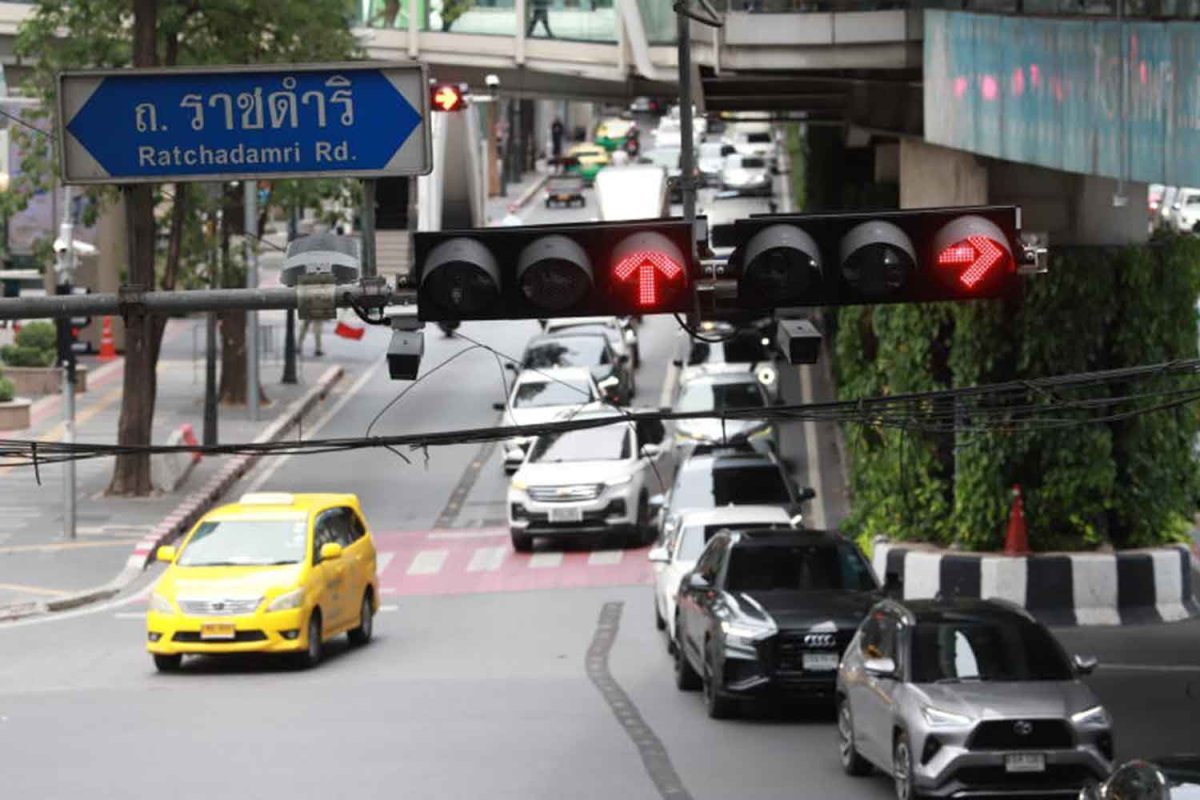

The Bangkok Metropolitan Administration (BMA) announced it will accelerate the implementation of adaptive traffic lights to ease congestion across the city. Currently, over 80% of Bangkok's 746 major intersections use fixed-time lights that operate on predetermined intervals, which often fail to adjust to varying traffic conditions. To address this, BMA Deputy Governor Wisanu Subsompon stated that the city aims to upgrade its traffic management system, utilizing CCTV and image processing for real-time traffic analysis.
Get today's headlines by email 
The fixed-time system has demonstrated inefficiencies, particularly during rush hours and traffic fluctuations, leading to "lost green time" and gridlock situations. The adaptive system, however, can customize signal timings automatically based on real-time traffic data, ensuring smoother flow and preventing intersection blockages. This technology examines traffic density and queue lengths up to 150 meters before an intersection to allocate green times optimally.
The adaptive system includes a Gridlock Protection feature, which stops green signals if downstream traffic cannot disseminate, thereby reducing the chance of blocked intersections. For the current fiscal year, the BMA plans to deploy this technology to an additional 50 intersections, significantly expanding its coverage in the city.
Experts predict that these improvements will enhance traffic efficiency and reduce congestion-related delays in Bangkok. By adapting to actual traffic volumes, the city expects to manage peak times more effectively and respond to unexpected traffic scenarios. The shift towards an adaptive system marks an important step in modernizing Bangkok’s traffic infrastructure, reported Bangkok Post.
Join the discussion? 
Already a member? 
 Adapted by ASEAN Now · Bangkok Post · 05 Mar 2026