




Analysts are outlining possible coalition arrangements ahead of Thailand’s general election, with no single party expected to secure enough seats to govern alone and coalition stability emerging as a central concern. Attention is focused on whether the People’s Party (PP) or Bhumjaithai finishes first, as both scenarios would require complex negotiations to reach a workable majority in the 500-seat House of Representatives.
Forming a government requires more thakn 250 seats, but most observers regard a 300-seat coalition as the benchmark for durability and political stability. Even if the PP wins the most seats, it is expected to face greater difficulties than Bhumjaithai unless it achieves a near-landslide victory close to 250 seats.
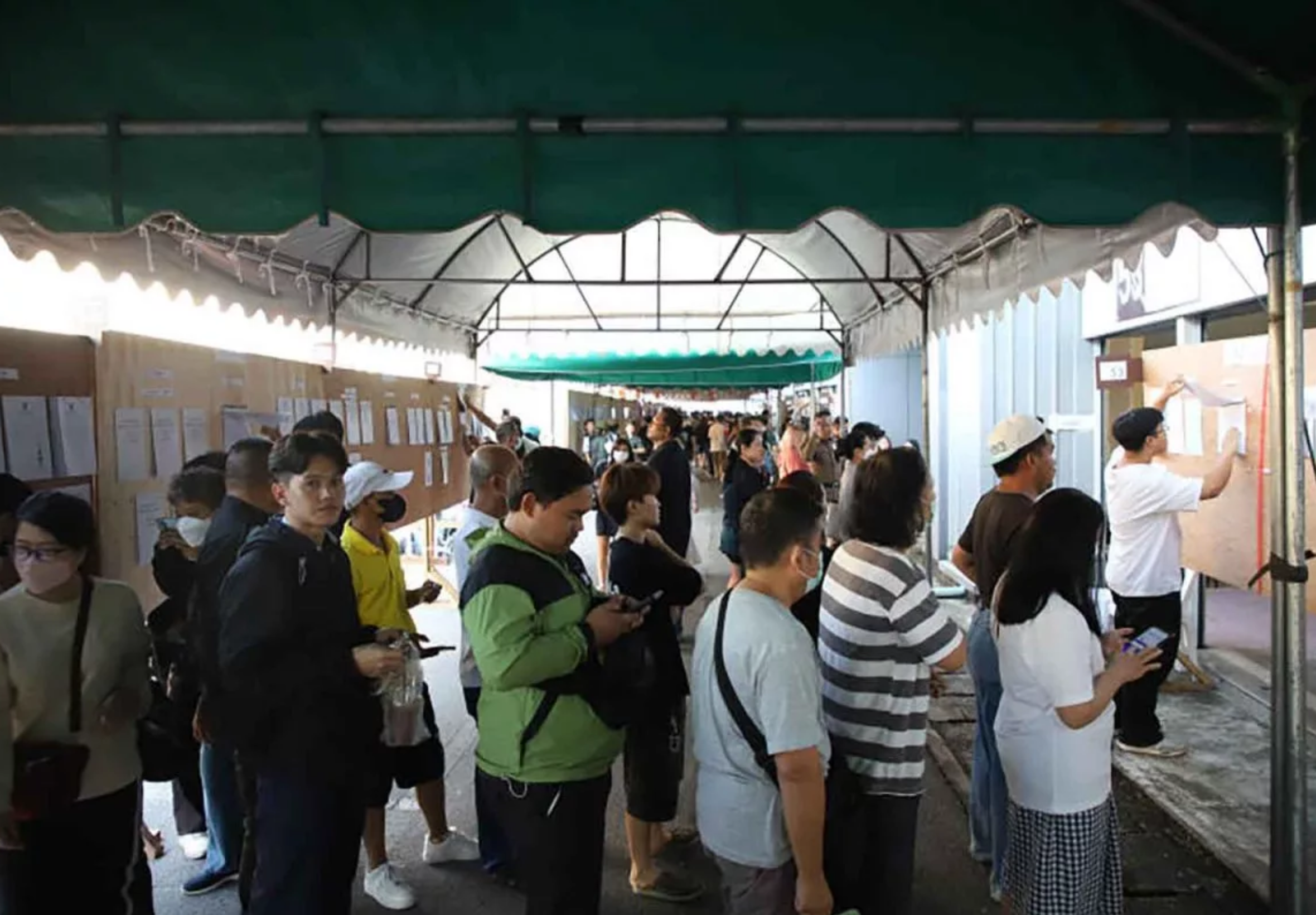
Advance voting took place on Feb 1, underscoring the immediate momentum of the electoral process. The election has prompted analysts to map scenarios based on projected seat counts and the willingness of parties to cooperate after polling concludes.
Many parties are expected to refuse cooperation with the PP, leaving Pheu Thai as its most plausible partner due to closer ideological alignment. If the PP secures around 150 seats, one potential coalition would combine the PP with Pheu Thai, projected to win 80–100 seats, alongside the Democrat Party and smaller parties such as Prachachat, bringing the total close to 300 seats.
If Bhumjaithai finishes first, with some forecasts placing it at around 150 seats and the PP at 130–150, two main options emerge. One would unite Bhumjaithai, Pheu Thai and the Klatham Party with support from smaller parties, while another would see Bhumjaithai and Pheu Thai join forces with the Democrats, both scenarios comfortably exceeding 300 seats.
Chaiyan Ratchakul, a political scientist at the University of Phayao, believes the PP is likely to lead the next government but warns it may not last long. He cited a pending legal case involving 44 MPs who signed a proposal to amend Section 112 of the Criminal Code as a potential trigger for the party’s removal from power.
Wanwichit Boonprong of Rangsit University said a Bhumjaithai–Pheu Thai–Klatham coalition is the most likely outcome due to their experience working together, though Klatham’s inclusion could raise public image concerns. Stithorn Thananithichot of Chulalongkorn University said Bhumjaithai, Pheu Thai and the PP have equal chances of finishing first, with a Bhumjaithai–Pheu Thai partnership seen as the most probable next step.
Bangkokpost reported that coalition talks are expected to hinge on cabinet negotiations, with Pheu Thai emerging as the key variable. Analysts expect post-election bargaining to determine not only who forms the government, but how long it can remain in power.

Key Takeaways
• A 300-seat coalition is widely viewed as the benchmark for stable governance in the next parliament.
• The PP may struggle to form a government without a near-landslide victory and Pheu Thai’s support.
• Bhumjaithai-led coalitions are seen as more straightforward due to prior governing experience.

Adapted by ASEAN Now from Bangkokpost 2026-02-05

