Skip to content
View in the app

A better way to browse. Learn more.

Thailand News and Discussion Forum | ASEANNOW

A full-screen app on your home screen with push notifications, badges and more.

To install this app on iOS and iPadOS
  1. Tap the Share icon in Safari
  2. Scroll the menu and tap Add to Home Screen.
  3. Tap Add in the top-right corner.
To install this app on Android
  1. Tap the 3-dot menu (⋮) in the top-right corner of the browser.
  2. Tap Add to Home screen or Install app.
  3. Confirm by tapping Install.

Electric Vehicles in Thailand

Featured Replies

1 minute ago, Pib said:

Yea...if my 2009 Toyota 3.0L diesel is almost empty it costs about the same as it has a 65L tank.


But the guy in the article where he said he pays Bt500 for almost a full tank in his truck was telling a fib. 


Now what I would believe from the guy is he typically tops-up "Bt500 at a time" because over the years I have seen many  many, many Thais pull up to the fuel station  (while I'm also fueling up) in their pickup truck or compact car and ask for Bt500 of fuel.  It's like that's their standard amount when fueling-up and maybe to them it's considered almost filling-up.


Fill up only 500 THB. Because they don't have more cash at the moment. Most of the time broke and living from hand into the mouth. Why do you think there are hundreds of these small packages (food and especially cosmetics) at 7-11 ? It's not for travelling or for kids. It's because people can't handle their monthly budget and cash, so they buy a 5ml cream package for the 20 THB they have leftover without realising that the markup for these small packages is often 300% or more compared to a standard packaging.

  • Replies 11.4k
  • Views 1.6m
  • Created
  • Last Reply

Top Posters In This Topic

Most Popular Posts

  • JBChiangRai
    JBChiangRai

    There's no point arguing with these anti-EV people, even when you educate them over their mistakes, they just repeat their baseless opinions somewhere else.  Frankly, it's tiresome.   I can'

  • i have been looking at a new suv, was thinking of hybrid, or ev, as the price of some brands have been reduced,   but ev's mg zs ev, havel, etc. are ok for short running about trips, but hav

  • JBChiangRai
    JBChiangRai

    Your assumption Thailand will follow, is I believe, false.   Two completely separate markets with separate circumstances.   What kickstarted the EV revolution here was BYD & GW

Posted Images

1 hour ago, Pib said:

Trucks like a Riddara RD6 are really for those who "don't really need a truck....really just want one to occasionally carry some household item that might be challenging to fit into their personal car.  Riddara trucks are not focused towards those who "really" need a truck in their personal and/or work lives; it's focused towards those that "just like having a truck but don't really need one" which is fine....a person can buy whatever they desire although it may not be a real need....we all "buy desires" almost everyday. 


Below article is a bit dated....from mid 2024 but I think it's still on target when it comes to tapping into the pickup truck market segment that "really need a truck" in Thailand.   I have no doubt many in this market segment will shift towards EV trucks...most likely those businesses who buy many vehicles to deliver their product/service which are driven by employees of the business.  Then the Somchai's who drive their own truck in their small business will begin to follow....it will be a gradual change over the next decade as EVs become cheaper, more accepted from the fearful, and more widely supported rather than only "repairable" at a dealership.


https://restofworld.org/2024/ev-pickup-trucks-thailand/

8 July 2024 • Pattaya, Thailand


Thailand is one of the biggest markets in the world for compact pickups. The one-ton trucks, used to haul produce, and modified to transport goods and people, make up nearly half of total vehicle sales in the country. 


“It is a very different market, as users are much more price-sensitive than EV car users,” he said. “Plus, most pickup truck users use the vehicle for long distances and for heavy loads, and there’s very little charging infrastructure up-country. EVs have already reached about 10% of passenger vehicle sales. Pickup trucks will be much slower to reach that figure because of these challenges.”


There are about 10,000 charging outlets in fewer than 3,000 locations across Thailand, with a concentration in the cities. For Bussaba Nakpipat, a durian farmer in the eastern town of Chanthaburi, this is a problem. Bussaba and her family transport the large, spiky fruit on two Toyota Hilux trucks and one Mitsubishi pickup — all of which are diesel-powered. They sometimes drive long distances several hours a day, so switching to a fully electric truck is not feasible, she told Rest of World.

“There are days when I have to make many trips, when I have to wait in line at the distribution center to offload the produce, and there are no charging stations around,” Bussaba said. “Now, I don’t really have to worry … I pay 500 baht ($14) for almost a full tank of diesel and know that when it runs out, I can always find another gas station.” 

Customers like Bussaba will probably make the shift to hybrid trucks first, to get over “range anxiety,” or the fear of having insufficient battery capacity while driving long distances, said Yamamoto. To win their trust, Toyota and Isuzu will have to test their vehicles for different conditions, Surapong Paisitpatanapong, vice chairman of FTI, told Rest of World. “The tests have to be extensive because pickup trucks are used to carry goods, often a lot of weight,” he said. “They have to be confident that they work as well as the fuel-powered models.”


Agree, almost all trucks are nothing more than crappy SUVs with a small bed for cargo.  I always had a truck back in USA, but they were work trucks.  The RD6 is a bit more :coffee1:


One advantage of the RD6, as a work truck, it can provide up to 6kW of power for electric tools from the cargo bed outlets.  That would come in handy for construction workers or 'handy'person on job sites, especially if electric isn't available yet.


Also as an RV conversion, outlets to use, and AC'd sleeping, my use for, although the bed still too small to sleep on (1.5m) so would have to make raised bed area.   No more 'pet friendly' accommodation issues, along with parking and sleeping anywhere desired.


image.png.c8c1126a3c535063620b19c9739bb96a.png


  • Author
21 minutes ago, yankee99 said:

It cost me 2300 baht in Diesel to fill my 2017 2.2L ford pick up 


It cost me zero Baht to fill up my 2 BYDs and my electric motorbike.


When I was building my house 8 years ago I was spending ฿5,000 a month on Diesel filling up my Triton 

2 hours ago, Pib said:

Trucks like a Riddara RD6 are really for those who "don't really need a truck....really just want one to occasionally carry some household item that might be challenging to fit into their personal car.  Riddara trucks are not focused towards those who "really" need a truck in their personal and/or work lives; it's focused towards those that "just like having a truck but don't really need one" which is fine....a person can buy whatever they desire although it may not be a real need....we all "buy desires" almost everyday. 


Below article is a bit dated....from mid 2024 but I think it's still on target when it comes to tapping into the pickup truck market segment that "really need a truck" in Thailand.   I have no doubt many in this market segment will shift towards EV trucks...most likely those businesses who buy many vehicles to deliver their product/service which are driven by employees of the business.  Then the Somchai's who drive their own truck in their small business will begin to follow....it will be a gradual change over the next decade as EVs become cheaper, more accepted from the fearful, and more widely supported rather than only "repairable" at a dealership.


https://restofworld.org/2024/ev-pickup-trucks-thailand/

8 July 2024 • Pattaya, Thailand


Thailand is one of the biggest markets in the world for compact pickups. The one-ton trucks, used to haul produce, and modified to transport goods and people, make up nearly half of total vehicle sales in the country. 


“It is a very different market, as users are much more price-sensitive than EV car users,” he said. “Plus, most pickup truck users use the vehicle for long distances and for heavy loads, and there’s very little charging infrastructure up-country. EVs have already reached about 10% of passenger vehicle sales. Pickup trucks will be much slower to reach that figure because of these challenges.”


There are about 10,000 charging outlets in fewer than 3,000 locations across Thailand, with a concentration in the cities. For Bussaba Nakpipat, a durian farmer in the eastern town of Chanthaburi, this is a problem. Bussaba and her family transport the large, spiky fruit on two Toyota Hilux trucks and one Mitsubishi pickup — all of which are diesel-powered. They sometimes drive long distances several hours a day, so switching to a fully electric truck is not feasible, she told Rest of World.

“There are days when I have to make many trips, when I have to wait in line at the distribution center to offload the produce, and there are no charging stations around,” Bussaba said. “Now, I don’t really have to worry … I pay 500 baht ($14) for almost a full tank of diesel and know that when it runs out, I can always find another gas station.” 

Customers like Bussaba will probably make the shift to hybrid trucks first, to get over “range anxiety,” or the fear of having insufficient battery capacity while driving long distances, said Yamamoto. To win their trust, Toyota and Isuzu will have to test their vehicles for different conditions, Surapong Paisitpatanapong, vice chairman of FTI, told Rest of World. “The tests have to be extensive because pickup trucks are used to carry goods, often a lot of weight,” he said. “They have to be confident that they work as well as the fuel-powered models.”


Oh yes, those super busy farmers and merchants that are driving all over the country non stop. It's BS. Of course they are stopping every five minutes for 7-11 or toilet or the next lunch meal or snack. Time, that with intelligent route planning could be easily used for charging the EV on the go for the rest of the day. Oh yes, and then there's the Alzheimer component like forgetting to charge the car over night.... 

  • Popular Post
1 minute ago, Bandersnatch said:


It cost me zero Baht to fill up my 2 BYDs and my electric motorbike.


When I was building my house 8 years ago I was spending ฿5,000 a month on Diesel filling up my Triton 

Same here, it was almost 10,000 THB for daily commuting every month, now it's down to 1,000 THB charging cost at home. Couldn't be happier 

On 9/21/2025 at 10:56 AM, Andrew Dwyer said:

First came the MG4 with its rear wheel drive and sporty look which was a pleasure to drive.

Then came the AWD X Power with bold new colours and increased performance/handling.


The two versions became instant good sellers and left MG with a dilemma:

” where to go from here ? “


In an unexpected turn of events MG decided to focus on the price and produced the 2026 MG4 cutting back on the sporty image, removing the AWD version, changing to front wheel drive and simplifying the suspension !!


Gone is the sporty hot hatch and welcome to another dull EV.

One has to wonder why they would reduce a successful sporty model to the level of the ZS replacement the S5 ?


The answer is money !!


Maybe it wasn’t selling well in China but here sold well as it did in Europe in particularly the U.K. !


 The previous MG 4 slotted in nicely between the sedate S5 and the sporty Cyberster or IM6 but now there is a huge gap between safe and exciting !!

I've said it in another a while ago when first Infos to the new MG4 surfaced. The new model is just ugly and has nothing to do with it's predecessor. Totally softened edges, no more more RWD, just another boring hatchback. Big dislike from me. The car that comes closest to the design of the old MG is the Deepal EV limousine (L07 ?). At least it has some edges 

12 minutes ago, CLW said:

Fill up only 500 THB. Because they don't have more cash at the moment. Most of the time broke and living from hand into the mouth. Why do you think there are hundreds of these small packages (food and especially cosmetics) at 7-11 ? It's not for travelling or for kids. It's because people can't handle their monthly budget and cash, so they buy a 5ml cream package for the 20 THB they have leftover without realising that the markup for these small packages is often 300% or more compared to a standard packaging.


If every 7-11, CJ's,  Big C Mini, Lotus Go Fresh, Tops Daily, etc.,  convenience store installed an EV charger that would place an EV charger about every 100 meters on the average all across Thailand.  And in some areas a lot less than 100 meters.   I think the number of 7-11's in Thailand should reach a gazillion pretty soon.😉

3 hours ago, Pib said:


If every 7-11, CJ's,  Big C Mini, Lotus Go Fresh, Tops Daily, etc.,  convenience store installed an EV charger that would place an EV charger about every 100 meters on the average all across Thailand.  And in some areas a lot less than 100 meters.   I think the number of 7-11's in Thailand should reach a gazillion pretty soon.😉

On a side note, the Thailand 7-11 is the worst franchise worldwide. In terms of product quality, range of products and customer services such as toilets, copying machine and seating areas 

43 minutes ago, CLW said:

On a side note, the Thailand 7-11 is the worst franchise worldwide. In terms of product quality, range of products and customer services such as toilets, copying machine and seating areas 

Toilets...copying machines...seating areas...bah humbug!!!! 


Go in, buy your Bt100 worth of snacks, pay a bill, and then climb back on the motorcycle the customer rode-in on.  


Fastest growing franchise operation in Thailand...approaching a gazillion...a 7-11 every 100 meters is the goal.  I think the average distance between Thailand 7-11's is currently around 200 meters.  😛

I got my BYD Sealion 7 Premium two weeks ago and I'm really happy with it! 

Already took it on a road trip to the northwest and distances of 500km+ are definitely doable on a single charge. 


We also got a free home charger (including installation). 

The problem is that we don't own the house. The landlord would probably be ok with us installing the wall charger though. 


Now my question: 


If we decide to move eventually how difficult would it be to take off the wall charger and build back everything? 


30 minutes ago, idealistic123 said:

I got my BYD Sealion 7 Premium two weeks ago and I'm really happy with it! 

Already took it on a road trip to the northwest and distances of 500km+ are definitely doable on a single charge. 


We also got a free home charger (including installation). 

The problem is that we don't own the house. The landlord would probably be ok with us installing the wall charger though. 


Now my question: 


If we decide to move eventually how difficult would it be to take off the wall charger and build back everything? 


I expect a landlord would be happy with you adding wall charger capability to his building especially since it's being done by certified installers vs a local Sparky with no to questionable credentials.   


Disconnecting the wall charger itself from its circuit breaker box that's going to be within 1 meter of the wall charger is easy...fast.   Just a  simple screw driver is needed to unhooked the wires from it's circuit breaker box...remove a few screws physically holding the charger to the wall...and you are done.  Off course be sure to turn of power at the main box to the EV charger when doing this.   You might even be able to get the charger installer to use CEE plugs to where the 7KW wall charger could be unplugged in a few seconds.


 You could also remove the EV circuit breaker in the main circuit box and the breaker real close to the charger very easily....once again just a screwdriver is needed.  


However, the wires and conduit running thru/on walls, ceilings, and any grounding rod pounded into the ground etc., would probably need to be left behind...that's typically the major labor and time involved in installing a wall mounted charger. 


Example of male and female CEE connectors

image.png.8161e1c5563ddd1dd7954b2d577c04b1.pngimage.png.5659830cb8e3fea86bc0cb5fd320f2a7.png


On 9/22/2025 at 8:22 PM, idealistic123 said:

I got my BYD Sealion 7 Premium two weeks ago and I'm really happy with it! 

Already took it on a road trip to the northwest and distances of 500km+ are definitely doable on a single charge. 


We also got a free home charger (including installation). 

The problem is that we don't own the house. The landlord would probably be ok with us installing the wall charger though. 


Now my question: 


If we decide to move eventually how difficult would it be to take off the wall charger and build back everything? 


As a landlord, I would have no problem with a tenant installing a wall charger, contingent on him fulfilling either of two options: A) The wall charger stays after he moves out, or B) everything that was modified to install the wall charger is removed entirely, without even a trace of the installation visible after removal.


Of course it goes without saying that the installation would have to be done by a certified electrician as mentioned by @Pib 


So my recommendation - check with your landlord what exactly you are allowed to do. 

@idealistic123

    I hope your landlord is not @mistral53 because he'll be a tough landlord!!  


@mistral53

   Boy, you are  tough landlord.  😉

    Curiosity question: if a tenant wanted to install say a clothes drier which typically draws around 25 amps and would require a new electrical run to the drier (which the tenant is paying to have installed).  And since clothes driers are then typically hard wired to a 32A circuit breaker at the end of the electrical wire run "would you require the tenant to leave the clothes driver behind when he moves or just require him to leave the wire run with circuit breaker he had installed in order to connect his clothes drier?   

    And yes, the clothes drier would probably require an approx 15cm in diameter hole in the wall for the hot air to exit (unless using a hose to exit the hot air via a window/door)...but a hole which made professionally can be temporarily plugged with a plastic cover (looks just fine) when the tenant moves and takes the drier just like he takes his big screen TV, microwave, etc....etc.....along with disconnecting the clothes drier wires which connected to the circuit breaker right next the drier.  And just to stress the tenant would not removing the wire run with circuit breaker....just unhooking the clothes drier wires that connect to the drier breaker. 


   Now installing a 7KW wall charger would really be a very similar setup (minus the hot air exit hole)....that is, an electrical run from the main circuit box to a breaker where the wall charger is hard wired into.  Or, maybe the tenant had a 40A electrical socket intalled and put a plug on the drier wires so it could simply be "plugged in"....makes it easy to just unplug the drier and take it away in a minute or two. 


   You would really require the tenant to also "leave the EV charger" which can be literally disconnect/removed to include it wall mounting bracket in 5-10 minutes (or even faster with it was installed with socket & plug)....then put a little bit of wall putty to fill-up the small holes drilled into the wall to hold the wall charger.   Probably using the same wall putty the tenant used to patch other small holes put in the inside walls to maybe hold a wall mounted TV, a heavy picture, shelves, etc. 


   I sure know if a landlord required me to also leave behind my EV charger (or clothes drier) I would not be renting from that guy.   As a tenant I could fully understand having to leave behind the electrical wire run/conduit unless having it professionally removed, but also having to leave behind the EV wall charger (or clothes drier or similar type of appliance).   To me a wall charger is just another higher amperage "appliance" which a tenant  that drives an EV wants to bring along and also leave with when moving out.


   But hey...I'm not a landlord but if someday I do become a landlord maybe I will have a change of mind and want the tenant to leave their EV charger behind if they don't want to have the the wiring/conduit/etc., professionally removed.   But knowing how easy and fast it is to remove a wall charger from the circuit breaker it hooks to and using some wall putty to patch a few holes where the wall charger mounted to the wall, I seriously double I would require the tenant to also leave behind the EV charging appliance.  


  • Popular Post
3 hours ago, Pib said:

@idealistic123

    I hope your landlord is not @mistral53 because he'll be a tough landlord!!  


@mistral53

   Boy, you are  tough landlord.  😉

    Curiosity question: if a tenant wanted to install say a clothes drier which typically draws around 25 amps and would require a new electrical run to the drier (which the tenant is paying to have installed).  And since clothes driers are then typically hard wired to a 32A circuit breaker at the end of the electrical wire run "would you require the tenant to leave the clothes driver behind when he moves or just require him to leave the wire run with circuit breaker he had installed in order to connect his clothes drier?   

    And yes, the clothes drier would probably require an approx 15cm in diameter hole in the wall for the hot air to exit (unless using a hose to exit the hot air via a window/door)...but a hole which made professionally can be temporarily plugged with a plastic cover (looks just fine) when the tenant moves and takes the drier just like he takes his big screen TV, microwave, etc....etc.....along with disconnecting the clothes drier wires which connected to the circuit breaker right next the drier.  And just to stress the tenant would not removing the wire run with circuit breaker....just unhooking the clothes drier wires that connect to the drier breaker. 


   Now installing a 7KW wall charger would really be a very similar setup (minus the hot air exit hole)....that is, an electrical run from the main circuit box to a breaker where the wall charger is hard wired into.  Or, maybe the tenant had a 40A electrical socket intalled and put a plug on the drier wires so it could simply be "plugged in"....makes it easy to just unplug the drier and take it away in a minute or two. 


   You would really require the tenant to also "leave the EV charger" which can be literally disconnect/removed to include it wall mounting bracket in 5-10 minutes (or even faster with it was installed with socket & plug)....then put a little bit of wall putty to fill-up the small holes drilled into the wall to hold the wall charger.   Probably using the same wall putty the tenant used to patch other small holes put in the inside walls to maybe hold a wall mounted TV, a heavy picture, shelves, etc. 


   I sure know if a landlord required me to also leave behind my EV charger (or clothes drier) I would not be renting from that guy.   As a tenant I could fully understand having to leave behind the electrical wire run/conduit unless having it professionally removed, but also having to leave behind the EV wall charger (or clothes drier or similar type of appliance).   To me a wall charger is just another higher amperage "appliance" which a tenant  that drives an EV wants to bring along and also leave with when moving out.


   But hey...I'm not a landlord but if someday I do become a landlord maybe I will have a change of mind and want the tenant to leave their EV charger behind if they don't want to have the the wiring/conduit/etc., professionally removed.   But knowing how easy and fast it is to remove a wall charger from the circuit breaker it hooks to and using some wall putty to patch a few holes where the wall charger mounted to the wall, I seriously double I would require the tenant to also leave behind the EV charging appliance.  


Well - this is the 'electric-vehicles-in-thailand/page/343' forum (how on earth could we even get this far......lol) - so I wont answer it here, or before we know it, we already drifted into the gutter like the rest of the AN threads. 


But for giggles, I give you one hint to your question: Most leases are for less than 5 years, so think about how Swiss-cheese like your property will look like in a few years if every tenant starts whacking holes, pulls cable conduits at will all over the place? 

This is exactly why I had the sparky fit a 32 amp industrial socket.  


When we move we just unplug the charger and take it with us.


If Thailand is anything like the UK, if it is wired in then it's a fixture and you can only remove it by notifying the buyer prior to sale.


If it's plugged in, then it's portable and no longer fixtures and fittings.

  • Popular Post

Thanks for your input! 


I haven't received the wall charger yet so let's see what I'll do with it. 


Currently I use the granny charger (8amp charger at 1.7 kWh) which is actually enough to top up 30-50km within a few hours. I usually don't drive more than in a day anyways. 

So the wall charger would be nice to have but not essential to use the car. 

22 minutes ago, idealistic123 said:

Thanks for your input! 


I haven't received the wall charger yet so let's see what I'll do with it. 


Currently I use the granny charger (8amp charger at 1.7 kWh) which is actually enough to top up 30-50km within a few hours. I usually don't drive more than in a day anyways. 

So the wall charger would be nice to have but not essential to use the car. 

Granny charging cable is more than enough for most people, and can charge overnight.   We rarely use our wall charger, since  having solar, being CC, and the wall charger is on the grid.


Only use it when we return from an O&A, as I like to return @ 20%, and keep the car @ 50%+, when home, since closest real hospital is 100 kms away.  


Retired and no kids / school schedule, so don't need the car to be charged up.   If no solar, granny over night would be 14 hr (1800-0800 hr) for most people, and ours, at least 2kWh per = 28kWh (60%) .   


Really no need for wall charger if using PEA/MEA anyway, as just quicker.  So buying second hand, one really wouldn't need to buy and have one installed. 

  • Popular Post
3 hours ago, mistral53 said:

Well - this is the 'electric-vehicles-in-thailand/page/343' forum (how on earth could we even get this far......lol) - so I wont answer it here, or before we know it, we already drifted into the gutter like the rest of the AN threads. 


But for giggles, I give you one hint to your question: Most leases are for less than 5 years, so think about how Swiss-cheese like your property will look like in a few years if every tenant starts whacking holes, pulls cable conduits at will all over the place? 


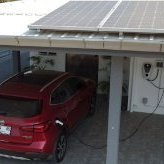
When it comes to EV wall chargers the installation can be quite simple with a minimum number of "holes" when finished.   Looks good.  Like below is my EV charger in my home carport.   It was  a free installation with charger when I bought my BYD Atto. 


Basically the installer ran three 10mm2  wires from the home's main circuit box thru existing conduit which  had others wires in the house leading to the circuit box.  Then these 10mm wires were run across and above the ceiling house ceilings panels (zero visible conduit) where one  25mm in diameter hole needed to be drilled thru a concrete wall above the ceiling panels between the house and carport area....then one more 25mm in diameter hole in the plaster board which is the ceiling of the carport area.  Summary: very little and small hole drilling to run the wires.   


Now that we are in the carport area then a 2 meter white conduit run from the ceiling down the wall to the charger breaker box.   Then the wall charger wires are hooked into the breaker box with the charger right next to it where the charger itself is held on the wall with a couple of small screws....and finally a couple of small screws holding the charger cable holder to the wall.   


All screws could be quickly patched with some wall putty when the charger is removed which then leaves behind just the charger conduit/wiring and its breaker box.   I would think that should make most landlords quite satisfied and also the tenant that is leaving since he gets to take along his  EV wall charger vs being PO'ed at the landlord would not allow him to take the charger.    


The charger and its cable & holder are the black colored stuff below.  When a tenant moved and wanted to take the charger he would just need to remove the charger by unhooking the cables from the breaker box (only takes a philips screwdriver) and then remove the charger assembly which is held by just a couple of screws in to the wall (philips screwdriver again) and then take it to his new residence.  Oh yea, then use a some wall putty to fill-in several small holes in the wall.    This would leave behind charger wires, conduit, and breaker box for the next tenant that could very well have an EV and wanting a residence where he could hook up a 7KW wall charger.    Seems this should satisfy both the outgoing tenant and landlord.   The landlord basically gets a free upgrade to his house and the tenant gets to take his EV charger when he leaves....seems to be a win-win situation to me. 


image.jpeg.be332ce5da3ed527aa7f8f059af931ae.jpeg

3 hours ago, idealistic123 said:

Thanks for your input! 


I haven't received the wall charger yet so let's see what I'll do with it. 


Currently I use the granny charger (8amp charger at 1.7 kWh) which is actually enough to top up 30-50km within a few hours. I usually don't drive more than in a day anyways. 

So the wall charger would be nice to have but not essential to use the car. 


That 1.7Kw granny charger would take 48 hours to completely fill-up (0 to 100%) from the Sealion 7 82.5KwH battery.....24 hours to go from 50 to 100%....almost 5 hours to add each 10% of charge.  No doubt that can meet most people's local driving needs....but it still results in granny charger being plugged into the EV a lot which in itself shouldn't be a issue. 


However, since BYD is giving you a free charger "and free installation" if your landlord will allow installation and not require you to also leave the 7KW wall charger behind when you leave....instead just leave the wire/conduit/breaker box....then I would think you would definitely want to have the 7KW charger installed.   


That way it would only take 12 hours (over night) to completely charge from 0 to 100%,  6 hours from 50 to 100%, and only around  1 hr 15 min for each 10%.....that's sure a lot faster than what granny can move along at.  

I have a 7kwh wall charger and a Seal with a 82.5 kw battery ( 80.5 kw usable i think ).

Due to charging losses i get 6.4kwh to the car from my 7 kWh charger which works out roughly at 8% an hour range.

Yea....I was keeping the math super simple/approximate without getting into the charging losses that are typically in the 7 to 10% ballpark for a 7KW AC charger hooked up to the EV's "onboard charger (OBC)."   And the bulk of that 7 to 10% loss is "not" due to the wall charger which is not really a charger since it's nothing more than a fancy relay and circuit breaker officially called an Electric Vehicle Supply Equipment (EVSE) that is always monitoring the AC power flow going thru it to the EV....the bulk of the losses are from the EV's onboard charger which is where the 220V AC voltage that's being fed into the EV is converted from AC power to DC power that is required to charge the EV's battery. 


 That onboard conversion process is where the bulk of the charging loss occurs when using an AC charger, but there is some minor losses in the EVSE itself and its charging cable from heat.  And a "granny" charger has an even higher loss in the 10 to 15% ballpark due to heating that occurs in the granny charger. its charging cable, etc.  


When using a DC Fast Charger the EV onboard charger is not used as the DC Fast Charger is feeding DC power directly to the EV's battery....1 to 3% charging loss typically occurs like in the charging cable, battery heat from the high charge rate, etc.  

6 hours ago, CallumWK said:

Let us know when it really happens, which in my opinion, will be never had


hope you still around when it happens ... because banning gas powered bikes in cities is a good thing ... :smile:

6 hours ago, CallumWK said:


Let us know when it really happens, which in my opinion, will be never

Worked in China a fare while ago now, but all bikes I saw were EVs.

Bit dangerous when crossing the road as you can't hear the bikes coming and they drive on the wrong side of the road.

I think it's a government thinggy. If they want EV bikes, then there will be EV bikes.

Doesn't matter in Vietnam that you can't hear them as when crossing the road, just GO.

11 hours ago, CallumWK said:


Let us know when it really happens, which in my opinion, will be never

Well, the helmet law worked in Vietnam. 

So I am confident the gasoline motorcycle ban in cities will be a success, too.

28 minutes ago, CLW said:

Well, the helmet law worked in Vietnam. 

So I am confident the gasoline motorcycle ban in cities will be a success, too.


Helmet law required an investment of a few dollar to comply, Electric motorcycle requires an investment of 1000 or more dollars, and devalues their current moped. Not the same

8 hours ago, carlyai said:

Worked in China a fare while ago now, but all bikes I saw were EVs.

Bit dangerous when crossing the road as you can't hear the bikes coming and they drive on the wrong side of the road.

I think it's a government thinggy. If they want EV bikes, then there will be EV bikes.

Doesn't matter in Vietnam that you can't hear them as when crossing the road, just GO.

Just think if people looked before crossing the street, then nobody would get run over.


E-MB are pretty quiet, and I've startled a couple people that didn't look before crossing.   Cars, not so much, or much quieter of a quiet ICEV.   Our ICE ZS was pretty quiet, idle & slow speed.   Many times standing next to, I couldn't tell if running or not, if a fan didn't engage.


Yesterday walking the dog, a MG HS approached on full electric, and I heard it, before it got near me.  Weigh of and tires on the road, along with the hum/wind of motors was enough.   And my ears aren't the best.  


You can't fix stupid, people will continue to get run over, no matter how loud or quiet the vehicle is.  That last thought will probably be the same for all .... "damn, I should have looked both ways"

On 9/26/2025 at 5:47 PM, Pib said:


When it comes to EV wall chargers the installation can be quite simple with a minimum number of "holes" when finished.   Looks good.  Like below is my EV charger in my home carport.   It was  a free installation with charger when I bought my BYD Atto. 


Basically the installer ran three 10mm2  wires from the home's main circuit box thru existing conduit which  had others wires in the house leading to the circuit box.  Then these 10mm wires were run across and above the ceiling house ceilings panels (zero visible conduit) where one  25mm in diameter hole needed to be drilled thru a concrete wall above the ceiling panels between the house and carport area....then one more 25mm in diameter hole in the plaster board which is the ceiling of the carport area.  Summary: very little and small hole drilling to run the wires.   


Now that we are in the carport area then a 2 meter white conduit run from the ceiling down the wall to the charger breaker box.   Then the wall charger wires are hooked into the breaker box with the charger right next to it where the charger itself is held on the wall with a couple of small screws....and finally a couple of small screws holding the charger cable holder to the wall.   


All screws could be quickly patched with some wall putty when the charger is removed which then leaves behind just the charger conduit/wiring and its breaker box.   I would think that should make most landlords quite satisfied and also the tenant that is leaving since he gets to take along his  EV wall charger vs being PO'ed at the landlord would not allow him to take the charger.    


The charger and its cable & holder are the black colored stuff below.  When a tenant moved and wanted to take the charger he would just need to remove the charger by unhooking the cables from the breaker box (only takes a philips screwdriver) and then remove the charger assembly which is held by just a couple of screws in to the wall (philips screwdriver again) and then take it to his new residence.  Oh yea, then use a some wall putty to fill-in several small holes in the wall.    This would leave behind charger wires, conduit, and breaker box for the next tenant that could very well have an EV and wanting a residence where he could hook up a 7KW wall charger.    Seems this should satisfy both the outgoing tenant and landlord.   The landlord basically gets a free upgrade to his house and the tenant gets to take his EV charger when he leaves....seems to be a win-win situation to me. 


image.jpeg.be332ce5da3ed527aa7f8f059af931ae.jpeg

Thanks for the detailed description and the picture. Makes it easier for me (who has no clue about electrical installations) to understand the whole process. 

It seems like I'm lucky then because the main fuse box of the house is located in the garage right next to the car. 


1.png.69444b4b5299d6477350b6fd055eb237.png

3 minutes ago, idealistic123 said:

Thanks for the detailed description and the picture. Makes it easier for me (who has no clue about electrical installations) to understand the whole process. 

It seems like I'm lucky then because the main fuse box of the house is located in the garage right next to the car. 


1.png.69444b4b5299d6477350b6fd055eb237.png


Typically the majority of the time spent installing a 7KW wallcharger (and the hardest part/most labor intensive part of the installation) is running the wire from the main circuit panel to the wall charger because many times the main circuit panel is meters and meters and meters away from where you want to install the charger and typically requires going thru a concrete wall (or two), maybe a ceiling, etc.   But it sure appears in your case only a very short wire run with minimum holes will be required.   Hopefully you have one open/unused breaker position in the main circuit box for the required 40A circuit breaker that will feed the charger (I'm assuming you have a single phase electrical system vs a three phase system).   There will be another 40A RCBO (safety & overload breaker) along with a cut off switch installed next to the charger. 


I would definitely talk to your landlord about wanting to install a wall charger....to include the free installation by a professional electrical contractor provided by BYD.   On the surface it appears installation should be easy and fast assuming you have a 100A single phase service to the home...based on what your main circuit box looks like I fully expect you have single phase service but as to whether it's 100A, 63A, etc., I can't say.  What is the amperage on the "main breaker" in the main circuit panel box?


Create an account or sign in to comment

Recently Browsing 0

  • No registered users viewing this page.

Account

Navigation

Search

Search

Configure browser push notifications

Chrome (Android)
  1. Tap the lock icon next to the address bar.
  2. Tap Permissions → Notifications.
  3. Adjust your preference.
Chrome (Desktop)
  1. Click the padlock icon in the address bar.
  2. Select Site settings.
  3. Find Notifications and adjust your preference.