Skip to content
View in the app

A better way to browse. Learn more.

Thailand News and Discussion Forum | ASEANNOW

A full-screen app on your home screen with push notifications, badges and more.

To install this app on iOS and iPadOS
  1. Tap the Share icon in Safari
  2. Scroll the menu and tap Add to Home Screen.
  3. Tap Add in the top-right corner.
To install this app on Android
  1. Tap the 3-dot menu (⋮) in the top-right corner of the browser.
  2. Tap Add to Home screen or Install app.
  3. Confirm by tapping Install.

Become a member

Become a member

World News

Fresh news brought to you daily from around the world. Hot news, breaking stories as they happen.
Migration added 171,000 people to the UK’s population in 2025, almost half the level recorded the previous year, according to new Home Office figures.

Get today's headlines by email

The total marks the lowest level since 2012 outside the Covid pandemic period, though Prime Minister Keir Starmer said there was still “more to do” to reduce numbers further.
The data also showed that 93,525 people claimed asylum in the UK in the year to March 2026, down 12% from the previous year but still more than double pre-pandemic levels.
Work Migration Continues to Decline
The Office for National Statistics said net migration had fallen to levels last seen in early 2021, when Britain introduced its post-Brexit immigration system and Covid travel restrictions were in place.
Sarah Crofts, deputy director at the ONS, said the decline was largely driven by fewer arrivals from outside the European Union, particularly for work-related visas.
Policy changes introduced in 2024 under the previous Conservative government are believed to have played a major role in the decline. The current Labour government has kept those measures and expanded some of them.
Restrictions included preventing most overseas students from bringing family members to the UK and limiting care workers from bringing dependants.
The salary threshold for skilled worker visas was also raised from £26,200 to £38,700, while the income requirement for sponsoring family visas increased by more than £10,000.
After Brexit, immigration rose sharply as Conservative ministers relaxed some visa rules for health and social care workers to address labour shortages. Critics referred to the increase as the “Boriswave”.
The government has since announced further measures, including requiring migrants to speak English to A-level standard and increasing the skilled worker salary threshold again to £41,700.
Asylum Numbers Remain High
Home Office figures showed asylum applications fell by 12% in the year to March 2026, although levels remain significantly above those seen before the pandemic.
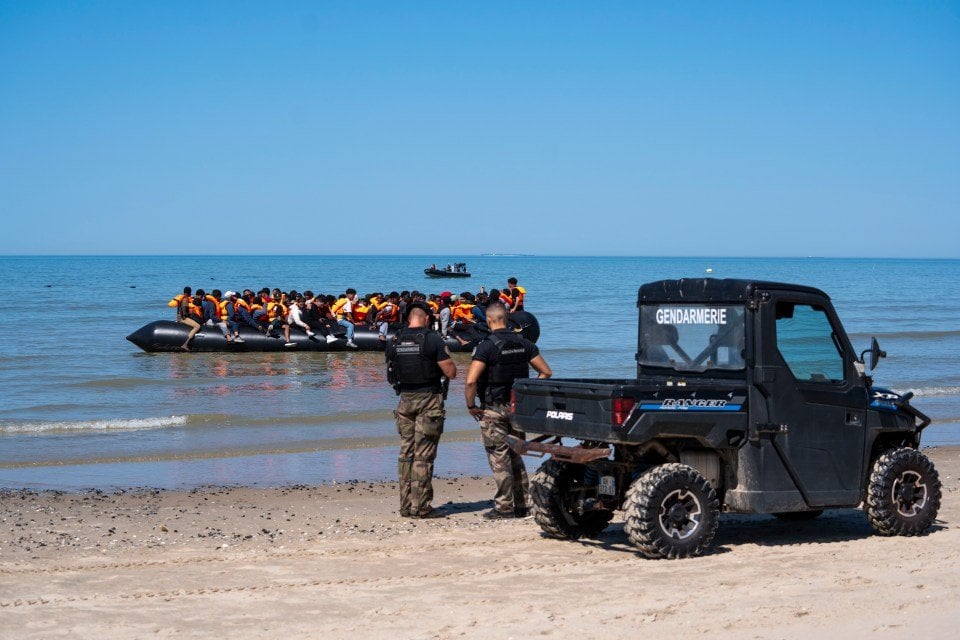
There were 43,806 detected arrivals through illegal routes during the same period, with small boat crossings accounting for 90% of cases.
The number of asylum seekers housed in hotels while awaiting decisions fell to 20,885 by March 2026. That compares with 30,657 in December 2025 and a peak of 56,000 recorded in September 2023.
Asylum hotels became a major political issue last year, triggering protests in places including Norwich, Epping and Mold.
In October, Starmer pledged to close all asylum hotels, saying he had inherited a “mess” from the Conservatives.
Home Secretary Shabana Mahmood said the latest figures showed “real progress” had been made in restoring control over Britain’s borders.
Political Parties Clash Over Migration
The ONS said just over 800,000 people immigrated to the UK in 2025, down 20% compared with the previous year.
Meanwhile, an estimated 642,000 people left the UK for long-term residence abroad in the year to December 2025.
Ben Brindle of the Migration Observatory said the economic impact of migration depended on who was arriving and leaving. He noted that migration among groups with broadly positive economic impacts had declined, while asylum-related migration remained comparatively high.
Shadow home secretary Chris Philp argued that immigration levels were still too high and called for stricter controls, including a binding annual cap on migration.
Meanwhile, Reform UK MP Robert Jenrick described the departure of British nationals from the UK as “the Starmer Exodus”, although the ONS said emigration among British citizens had remained broadly stable in recent years.
The Liberal Democrats blamed Brexit for the number of Britons leaving the country and urged the government to strengthen cooperation with European allies.

Join the discussion?

Already a member?


Adapted by ASEAN Now. Source 22 May 2026
webfact
webfact
A Tennessee county has agreed to pay $835,000 to settle a lawsuit brought by a retired police officer who spent 37 days in jail over a Facebook post linked to the killing of conservative activist Charlie Kirk.

Get today's headlines by email

Larry Bushart, 61, was arrested in September after refusing to remove memes and comments about Kirk’s assassination from his Facebook page. Authorities in Perry County charged him with a felony, though prosecutors later dropped the case in October.
Bushart filed a federal lawsuit in December against Perry County, Sheriff Nick Weems and the investigator who secured the arrest warrant. He argued that his constitutional right to free speech had been violated.
“I am pleased my First Amendment rights have been vindicated,” Bushart said in a statement announcing the settlement on Wednesday. He added that freedom of expression and public debate were essential in a democracy and said he wanted to focus on spending time with his family.
Arrest followed controversial meme
The case drew national attention because criminal prosecutions over social media comments are uncommon, even when online posts lead to public backlash or employment consequences.
Bushart’s arrest stemmed from a meme featuring President Donald Trump alongside the quote “We have to get over it.” The image referred to remarks Trump made after a January 2025 school shooting in Perry, Iowa, which killed two people and injured six others.
Bushart shared the meme with the caption: “This seems relevant today…”
Some residents interpreted the post as a threat directed at Perry County High School in Linden, Tennessee. Sheriff Weems later said investigators believed Bushart intended to provoke fear in the local community, although the sheriff acknowledged that the meme itself referred to the Iowa school shooting.
Perry County had recently held a candlelight vigil following Kirk’s death, reflecting strong local sympathy for the conservative commentator.
Time in jail and fallout
Bushart remained in custody for more than a month after his bail was initially set at $2 million. During that time, he lost a post-retirement job and missed both his wedding anniversary and the birth of his granddaughter, according to the lawsuit.
The case became a focal point in debates over free speech and the limits of online expression, particularly when public officials view social media content as potentially threatening.
Bushart was represented in part by the Foundation for Individual Rights and Expression, a civil liberties group focused on free speech issues.
Free speech concerns highlighted
Cary Davis, an attorney involved in the case, said the settlement underscored constitutional protections for speech during periods of public tension.
“It’s in times of turmoil and heightened tensions that our national commitment to free speech is tested the most,” Davis said. He added that the settlement should serve as a warning to law enforcement agencies about the consequences of violating First Amendment protections.
The settlement resolves the lawsuit without a trial and closes one of the more prominent legal disputes arising from online reactions to Kirk’s killing.

Join the discussion?

Already a member?


Adapted by ASEAN Now. Source 21 May 2026
webfact
webfact
The United States plans to admit 10,000 additional white South Africans as refugees this year, with the Trump administration describing the move as a response to what it called an “emergency refugee situation” in South Africa.

Get today's headlines by email

The decision raises the planned intake of mostly white Afrikaner refugees from about 7,500 to 17,500 for the fiscal year ending in September.
Since returning to office last year, President Donald Trump has repeatedly claimed that white Afrikaners in South Africa are being racially targeted and face a “white genocide”. South Africa’s government has strongly rejected those accusations.
Claims of discrimination
The administration has also taken several diplomatic steps against South Africa, including cutting aid, boycotting last year’s G20 summit in Johannesburg and excluding the country from this year’s G20 gathering, which is due to take place at one of Trump’s resorts in Miami.
The US began accepting white South Africans as refugees in May 2025, even as it suspended refugee admissions for people fleeing conflicts and persecution in countries such as Afghanistan, Sudan and the Democratic Republic of the Congo.
In the fiscal year ending September 2024, before Trump returned to office, the US admitted more than 100,000 refugees overall.
Emergency notice to Congress
On Monday, the US state department sent Congress an emergency notification outlining the expanded refugee programme.
According to the Associated Press, which reviewed the document, the cost of resettling the additional 10,000 Afrikaners is estimated at around $100m (£75m).
The notice said “unforeseen developments in South Africa created an emergency refugee situation” and accused South African officials and political parties of undermining the US refugee programme.
It also referred to a December raid by South African authorities on a US refugee processing centre. At the time, Washington described the action as “unacceptable”.
South Africa’s government said the operation targeted seven Kenyan nationals who were allegedly working in the country illegally without permits.
The state department argued that growing hostility toward the programme increased risks for Afrikaners, whom it described as facing “government-sponsored race-based discrimination”.
South Africa’s inequality debate
Afrikaners are descendants of mainly Dutch and French settlers who dominated South Africa during apartheid, the system of racial segregation that ended in the early 1990s.
Under apartheid, the white minority held political and economic power while the black majority faced severe restrictions and widespread poverty.
Since the election of Nelson Mandela as South Africa’s first black president, governments have introduced affirmative action and “black economic empowerment” policies aimed at addressing historic inequalities.
Despite those reforms, South Africa remains one of the world’s most unequal societies.
Official figures show unemployment among white South Africans stands at about 12%, compared with roughly 48% among black South Africans.
Some white South Africans argue that affirmative action policies now unfairly disadvantage them, while high crime levels have contributed to feelings of insecurity across communities.
Far-right conspiracy theory
Claims of a “white genocide” in South Africa have long circulated among far-right groups internationally, often focusing on attacks against white farmers.
The theory has repeatedly been dismissed by experts and South African authorities, who say there is no evidence of a coordinated campaign targeting white citizens.
In recent years, the narrative has also been promoted by South Africa-born billionaire Elon Musk and conservative media figure Tucker Carlson.

Join the discussion?

Already a member?


Adapted by ASEAN Now. Source 21 May 2026
webfact
webfact
Allied governments condemn footage shared by Israeli minister showing detained Gaza flotilla activists being mocked and restrained

Get today's headlines by email

Israel’s far-right national security minister, Itamar Ben-Gvir, has triggered a wave of international condemnation after publishing footage showing Israeli security forces detaining and mocking foreign activists intercepted while attempting to deliver aid to Gaza.
The video, shared online by Ben-Gvir, shows dozens of detainees kneeling in rows with their hands zip-tied behind their backs and their heads lowered to the ground. In one scene, the minister waves an Israeli flag while taunting a restrained activist and shouting slogans in Hebrew.
The footage prompted sharp criticism from several governments whose citizens were among those detained, including the UK, Canada, Germany, Spain, Ireland and the Netherlands.
US ambassador to Israel Mike Huckabee described Ben-Gvir’s conduct as “despicable”, saying the minister had “betrayed the dignity of his nation”.
European leaders condemn treatment
Italian Prime Minister Giorgia Meloni called the images “unacceptable” and demanded the immediate release of Italian nationals held by Israel, along with an apology over what she described as degrading treatment.
“It is inadmissible that these demonstrators, including many Italian citizens, are subjected to this treatment that violates human dignity,” Meloni said in a statement posted on social media.
Spain’s foreign minister condemned the scenes as “monstrous, disgraceful and inhumane”, while UK Home Secretary Yvette Cooper said she was “truly appalled” by the footage and had been in contact with the families of British citizens detained by Israeli authorities.
More than 400 activists from 40 countries were taking part in the flotilla mission, according to organisers. The group travelled aboard 50 vessels carrying food and humanitarian supplies in an attempt to challenge Israel’s blockade of Gaza.
Israeli forces intercepted the flotilla in international waters on Tuesday and transported those onboard to Israel.
South Korean President Lee Jae Myung also criticised the operation, questioning the legal basis for arrests carried out outside Israeli territorial waters.
Netanyahu distances himself from minister
The backlash quickly spread داخل Israel’s own government, with Prime Minister Benjamin Netanyahu publicly distancing himself from Ben-Gvir’s actions within hours of the video appearing online.
“The way that minister Ben-Gvir dealt with the flotilla activists is not in line with Israel’s values and norms,” Netanyahu said, adding that he had instructed authorities to deport the detainees “as soon as possible”.
Foreign Minister Gideon Saar issued an even stronger rebuke, accusing Ben-Gvir of damaging Israel’s international standing.
“You knowingly caused harm to our state in this disgraceful display – and not for the first time,” Saar wrote on X. “You are not the face of Israel.”
Rights groups warn of broader abuse
Human rights organisations said the incident reflected wider concerns over the treatment of detainees during the Gaza conflict.
Public Committee Against Torture in Israel said the video demonstrated a culture of impunity surrounding abuse in Israeli detention facilities.
Sari Bashi, the group’s director, said the public nature of the footage sent a dangerous message to prison staff and security personnel.
Legal advocacy group Adalah, which represents some of the detained activists, said similar allegations had emerged during previous flotilla operations without accountability.
The controversy came a day after Israeli Finance Minister Bezalel Smotrich announced plans to remove residents from the Palestinian village of Khan al-Ahmar in the occupied West Bank.
Israeli newspaper Haaretz reported this week that prosecutors at the International Criminal Court were seeking arrest warrants for several Israeli officials, including Ben-Gvir and Smotrich.


Join the discussion?

Already a member?


Adapted by ASEAN Now. Source 21 May 2026
webfact
webfact
Two Russian fighter jets carried out what the UK has described as dangerous interceptions of an unarmed Royal Air Force surveillance aircraft over the Black Sea last month, according to the Ministry of Defence.

Get today's headlines by email

The incident involved a British RC-135W Rivet Joint intelligence aircraft operating in international airspace as part of a routine mission supporting NATO’s eastern flank.
British officials said a Russian Su-35 fighter jet approached the aircraft closely enough to trigger its emergency safety systems, temporarily disabling the plane’s autopilot. A second aircraft, a Su-27, reportedly made six separate passes directly in front of the RAF aircraft, at one point coming within six metres of its nose.
Rising tensions over the Black Sea
UK Defence Secretary John Healey condemned the manoeuvres as “dangerous and unacceptable”, praising the RAF crew for what he described as their professionalism during the encounter.
Healey said the incident highlighted the risks posed by Russian military activity near NATO operations.
“These actions create a serious risk of accidents and potential escalation,” he said.
The Ministry of Defence described the interceptions as the most serious Russian aerial encounter involving the RAF since 2022, when a Russian pilot fired a missile near another Rivet Joint aircraft over the Black Sea.
British and foreign office officials have since summoned representatives from the Russian embassy and called on Moscow to condemn the conduct of its pilots.
Concerns over Russian military activity
The latest confrontation comes amid broader concerns in London and among NATO allies over increased Russian military activity around Europe’s borders.
The MoD pointed to recent Russian submarine operations near critical underwater infrastructure in the North Sea as further evidence of heightened aggression.
Officials stressed that the RAF aircraft involved in the Black Sea incident was unarmed and flying legally in international airspace.
Despite the encounter, the UK said it would continue surveillance and support operations alongside NATO allies.
“We remain committed to defending NATO, our allies and our interests from Russian aggression,” Healey said.
Echoes of the 2022 missile incident
The encounter has drawn comparisons with a September 2022 incident involving another RAF Rivet Joint aircraft over the Black Sea.
At the time, a Russian pilot fired two missiles towards the British aircraft. Russia initially claimed the launch resulted from a technical malfunction.
However, later reports citing Western defence sources said the missile firing followed confusion over instructions received from a Russian ground station, suggesting the pilot may have misunderstood an order.
The UK government publicly accepted Moscow’s explanation at the time in an effort to avoid escalation.
The RAF’s RC-135W Rivet Joint aircraft, operated by No. 51 Squadron from Lincolnshire, is used for signals intelligence missions. According to the RAF, the aircraft collects and analyses electronic signals to provide strategic and tactical intelligence in real time.

Join the discussion?

Already a member?


Adapted by ASEAN Now. Source 21 May 2026
webfact
webfact
Iran has outlined new conditions for ending hostilities with the United States and Israel, including reparations for war damage, the withdrawal of U.S. forces from areas near Iran and an end to attacks on Tehran and its allied group in Lebanon.

Get today's headlines by email

According to Iran’s state-run IRNA news agency, the proposal also calls for sanctions relief, the release of frozen Iranian funds and the removal of what Tehran describes as a U.S. blockade through the Strait of Hormuz.
The demands represent Tehran’s first public comments on its latest peace offer. Reports indicate the proposal remains largely unchanged from an earlier version rejected by President Donald Trump last week.
Diplomatic Efforts Continue
The revised plan was reportedly passed to Washington through Pakistan in recent days as regional mediation efforts intensified.
The proposal emerged as Trump announced on Monday that he would delay planned renewed military strikes against Iran. The president said the decision followed requests from leaders in Qatar, Saudi Arabia and the United Arab Emirates, who are seeking to prevent further escalation in the conflict.
Trump said “serious negotiations are now taking place” to find a diplomatic solution to the war.
Despite the delay, Trump signalled that military action remains under consideration. He is expected to meet senior national security officials on Tuesday to discuss possible next steps, according to sources cited by Axios.
Speaking to reporters at the White House, Trump said he was “an hour away from making the decision” on whether to launch strikes.
“The attacks would have been happening right now,” he said, adding that military assets were fully prepared.
He also warned that Iran had “two or three days” to show progress in negotiations, though he suggested he could extend the timeframe to a week.
Stalemate Over Talks
Efforts to reach a settlement have repeatedly stalled in recent weeks, with both Washington and Tehran rejecting proposals from the other side.
Last week, Trump dismissed an Iranian request to separate nuclear negotiations from broader peace discussions, calling the idea “totally unacceptable.”
Iran has continued to insist that any agreement must address the wider conflict and economic restrictions imposed on the country.
Economic Pressure Builds
The conflict has also created mounting economic concerns for the United States and its allies, particularly over disruptions linked to the Strait of Hormuz, one of the world’s most important oil shipping routes.
Rising energy prices and fears of prolonged instability in the region have increased pressure on the Trump administration to avoid a wider war and secure a negotiated settlement.
The Strait of Hormuz remains central to global energy markets, with a significant share of the world’s oil exports passing through the narrow waterway.


Join the discussion?

Already a member?


Adapted by ASEAN Now. Source 21 May 2026
webfact
webfact
China’s leader Xi Jinping has hosted Russian President Vladimir Putin in Beijing just days after receiving US President Donald Trump, staging two high-profile meetings that underline China’s ambition to position itself at the centre of global diplomacy.

Get today's headlines by email

Putin’s arrival outside the Great Hall of the People followed a carefully choreographed welcome: cheering schoolchildren, a military honour guard, cannon fire and a marching band. The ceremony closely resembled the reception given to Trump during his own visit the previous week.
Two major presidential visits in such quick succession highlight the image Beijing appears keen to project — a global power able to engage with rival leaders while remaining aligned with none.
For Chinese officials, the visits demonstrate the country’s growing economic weight and diplomatic reach.
“The new era of world affairs is less centered around the West,” said Samir Puri of King’s College London, noting that China often uses its influence gradually rather than directly intervening in conflicts.
Russia leans on Beijing
Despite the similar ceremonial treatment, the political context surrounding Putin’s visit differed significantly from Trump’s.
Putin has travelled to China more than 20 times and is widely seen as having a close personal relationship with Xi. Yet Russia’s war in Ukraine and sweeping Western sanctions have pushed Moscow into greater dependence on Beijing.
China is now Russia’s largest trading partner and its biggest customer for oil and gas, strengthening what analysts describe as an already uneven relationship.
Talks between the two leaders concluded with more than 20 agreements covering trade and technology. However, there was no approval for a long-delayed Russian gas pipeline project that Moscow has sought for years. A lengthy joint statement issued afterwards also produced few major breakthroughs.
“Both China and Russia need each other, but Russia clearly needs China more than before on the global stage,” said Zheng Runyu of the Centre for Russian Studies at East China Normal University in Shanghai.
China’s shifting diplomatic approach
Xi also appeared to negotiate from a position of strength in meetings with Trump.
China’s expanding trade links worldwide, alongside its dominance in rare earth minerals and advanced manufacturing, have given Beijing greater leverage in its dealings with Washington.
Both Trump and Putin also face ongoing military conflicts that have proved costly and prolonged. The war in the Middle East has become a global crisis affecting Trump politically at home, while Russia’s invasion of Ukraine has entered its fifth year and left Moscow increasingly isolated internationally.
Against that backdrop, analysts say Beijing has been able to set the tone for its engagements with both leaders.
The situation marks a notable shift from just a few years ago. During the COVID-19 pandemic, China closed its borders and faced rising tensions with Western governments. Relations deteriorated further amid confrontational “wolf warrior” diplomacy and criticism over human rights concerns in Xinjiang and Beijing’s tightening control over Hong Kong.
Western countries imposed sanctions and export controls, while China responded with countermeasures.
Diplomatic ambitions and limits
Five years later, China has sought to reposition itself as an indispensable centre for diplomacy and trade.
Beijing has moderated its diplomatic tone and worked to repair ties with countries such as Australia, Canada and the United Kingdom. Leaders from several Western nations have visited Beijing to strengthen economic cooperation with the world’s second-largest economy.
Xi has long promised what he calls the “great rejuvenation of the Chinese nation”, and the recent sequence of state visits provides a powerful domestic image of China as a country courted by global leaders.
Yet the meetings have also highlighted limits to Beijing’s influence.
During discussions with Putin, Xi urged an end to the conflict involving Iran, describing a halt to the war as “of utmost urgency”. However, he made no mention of Russia’s invasion of Ukraine.
China has attempted to maintain a neutral position on the war in Ukraine, though the United States and European governments have repeatedly urged Beijing to cut the economic support they say is helping sustain Russia’s war effort.
Analysts say China faces a difficult balancing act. While calling for peace in some conflicts, its reluctance to criticise Moscow risks undermining its claim to act as a neutral global broker.
At the same time, instability in Iran and disruptions to shipping through the Strait of Hormuz directly affect Chinese economic interests, particularly energy supplies.
Xi’s diplomatic push therefore comes with challenges, especially in Europe, where governments remain wary of China’s intentions and its close ties with Moscow.


Join the discussion?

Already a member?


Adapted by ASEAN Now. Source 21 May 2026
webfact
webfact
A parliamentary committee has sharply criticised the British government’s handling of plans to introduce digital identification, describing the initial rollout as “nothing short of a fiasco”.

Get today's headlines by email

In a report examining the policy, the UK Home Affairs Select Committee said ministers failed to properly explain their intentions when the scheme was first announced, sparking public concern and political backlash.

Prime Minister Keir Starmer unveiled plans in September last year to introduce compulsory digital identification for workers. The proposal was designed in part to combat illegal employment by making identity checks easier for employers.
However, the government reversed course three months later after strong criticism from opposition politicians and civil liberties groups.
Sudden announcement sparks backlash
According to the committee’s findings, the initial announcement came as a surprise to the public and lacked sufficient detail.
Committee chair Karen Bradley said the government’s communication had created unnecessary alarm about the scope of the programme.
“The government’s early attempts to set out its plans for digital ID were nothing short of a fiasco,” she said in the report.
Bradley said the proposal appeared suddenly and left ministers unable to answer key questions about how the system would operate or how personal data would be protected. As a result, many people feared the policy could represent excessive government intrusion into private life.
She added that public opinion had previously been broadly supportive of moving away from paper documents toward digital identification but that the poorly explained rollout had unsettled voters.
Shift from mandatory to voluntary system
The government has since abandoned the idea of compulsory digital identification.
Instead, it is continuing with plans to offer a voluntary digital ID that people can store on their smartphones, similar to digital payment cards.
The app-based identification would include basic personal information such as name, nationality, date of birth, photograph and residency status. It could be used to confirm a person’s age or their right to live and work in the United Kingdom.
Ministers initially argued that digital verification could help reduce the use of fraudulent documents or borrowed National Insurance numbers by people working illegally.
But the proposal quickly attracted criticism from privacy advocates. Campaign group Big Brother Watch warned that digital identification systems could raise serious privacy concerns.
A petition submitted to UK Parliament opposing digital ID gathered around three million signatures, with critics arguing the policy risked enabling mass surveillance.
By January, the government dropped the requirement that digital IDs be mandatory.
Effort to rebuild trust
The policy was relaunched in March as a voluntary programme, with ministers presenting it as a tool to simplify access to government services.
Cabinet Office minister Darren Jones opened an eight-week public consultation and established a “people’s panel” of 100 individuals from across the country to help shape the scheme.
Bradley welcomed the decision to remove the mandatory element but said consultation should have taken place earlier rather than after the policy was relaunched.
She also welcomed assurances that the government would not create a centralised database for the digital identification system.
However, the committee warned that public trust would be crucial for the project’s success.
Bradley said digital ID could only gain widespread use if people believed their information was secure, stressing the need for strong privacy protections and cyber security standards.
“Digital ID will not achieve widespread adoption unless the majority of people can trust that their data is secure,” she said.
She added that rebuilding confidence would take time and warned that further mistakes could seriously damage public support for the programme.

Join the discussion?

Already a member?


Adapted by ASEAN Now. Source 21 May 2026
webfact
webfact
The administration of US President Donald Trump has indicted former Cuban President Raul Castro over the 1996 shooting down of two aircraft operated by the Miami-based exile organisation Brothers to the Rescue, escalating tensions between Washington and Havana.

Get today's headlines by email

Federal prosecutors unsealed the indictment on Wednesday, accusing Castro, who was Cuba’s defence minister at the time, of helping direct the attack in which Cuban fighter jets destroyed two civilian planes on February 24, 1996.
US authorities charged Castro with conspiracy to kill US nationals, four counts of murder and two counts of destroying an aircraft. Five additional defendants were also named in the case.
Four men were killed in the attack: Carlos Costa, Armando Alejandre Jr, Mario de la Pena and Pablo Morales.
US frames charges as long-awaited justice
Announcing the indictment at Miami’s Freedom Tower, acting Attorney General Todd Blanche said the families of the victims had waited nearly three decades for accountability.
Blanche described the victims as “unarmed civilians” carrying out humanitarian missions aimed at helping Cuban migrants crossing the Florida Straits.
“Nations and their leaders cannot be permitted to target Americans, kill them, and not face accountability,” he said.
Kash Patel called the indictment “a major step toward accountability”.
Brothers to the Rescue was founded in 1991 by Cuban exile Jose Basulto during a period of increased migration from Cuba to the United States. The group used aircraft to search for Cuban rafters at sea and alert the US Coast Guard.
The United States and international investigators concluded the planes were shot down over international waters. Cuba has long maintained the aircraft violated or approached its airspace.
Former Cuban leader Fidel Castro previously denied that he or Raul Castro directly ordered the attack.
Havana rejects accusations
Cuba’s current president, Miguel Diaz-Canel, dismissed the indictment as politically motivated and accused the Trump administration of distorting the events of 1996.
Writing on social media, Diaz-Canel said the case was intended to justify possible military action against Cuba.
Foreign Minister Bruno Rodriguez Parrilla also criticised the White House after it issued a statement marking Cuba’s independence day and condemning the island’s communist leadership.
Deputy Foreign Minister Carlos de Cossio accused the administration of catering to anti-Castro Cuban exiles in South Florida, a key Republican support base.
Analysts see broader pressure campaign
Political analysts said the indictment appeared to fit within a wider US campaign to increase pressure on Havana.
Orlando Perez, a political science professor at the University of North Texas at Dallas, said Washington seemed to be pursuing both private negotiations and public confrontation with Cuba’s leadership.
Perez pointed to recent reports involving alleged Cuban interest in drone and asymmetric warfare capabilities, including possible threats targeting the US naval base at Guantanamo Bay and nearby areas in Florida.
He warned that the indictment could strengthen hardline elements within Cuba’s ruling establishment rather than weaken them.
William Leogrande, a specialist in Latin American politics at American University School of Public Affairs, said the move would likely be popular among Cuban Americans in South Florida but could further damage prospects for diplomacy between the two countries.
“It appears that the Trump administration is trying to lay the political groundwork for military action against Cuba,” he said.
Debate grows over possible military action
The Trump administration has repeatedly threatened military action against Cuba in recent months, though critics argue such a move would face broad opposition in the United States.
Lee Schlenker of the Quincy Institute for Responsible Statecraft said Cuba posed little direct threat to US national security and warned harsher sanctions or military action could trigger a humanitarian crisis and increased migration.
Some Democrats in Congress have already sought to restrict potential military action. Senators Ruben Gallego, Tim Kaine and Adam Schiff introduced a Senate war powers resolution earlier this year requiring congressional approval before any aggressive action against Cuba.
The lawmakers renewed those efforts following Wednesday’s announcement.


Join the discussion?

Already a member?


Adapted by ASEAN Now. Source 21 May 2026
webfact
webfact
The U.S. Senate has taken a step toward limiting President Donald Trump’s authority to conduct military operations against Iran, after a resolution advanced for the first time following several previous attempts.

Get today's headlines by email

Senators voted 50–47 on Tuesday to discharge the proposal from committee, allowing it to move forward for broader consideration in the chamber. The measure has been championed by Tim Kaine, a Democrat from Virginia, who argues that Congress should have a greater role in decisions about military engagement with Iran.
Four Republican senators — Susan Collins of Maine, Lisa Murkowski of Alaska, Rand Paul of Kentucky and Bill Cassidy of Louisiana — joined most Democrats in backing the procedural step. John Fetterman of Pennsylvania was the only Democrat to vote against advancing the measure.
The result marks the first time Cassidy has supported moving a war powers resolution forward. His vote came shortly after he failed to secure enough support to reach a runoff in the Louisiana Republican Senate primary, where Trump had endorsed a rival candidate.
Republican absences influence outcome
Three Republican senators — John Cornyn of Texas, Tommy Tuberville of Alabama and Thom Tillis of North Carolina — did not vote. Their absence helped tip the balance in favour of Democrats, who had previously failed seven times to advance similar resolutions relating to Iran.
Following the vote, Senate Minority Leader Chuck Schumer said the outcome showed growing Republican willingness to challenge the president’s approach to the conflict.
“Vote by vote, Democrats are breaking through Republicans’ wall of silence on Trump’s illegal war,” Schumer said in a statement, adding that the latest vote suggested momentum was building to curb the president’s authority.
Proposal seeks congressional approval for hostilities
Kaine’s resolution would direct the president to withdraw U.S. forces from hostilities involving Iran unless Congress explicitly authorizes military action through a declaration of war or a specific authorization for the use of military force.
The vote only clears an initial procedural hurdle in the Senate. Even if the resolution eventually passes both chambers of Congress, Trump would be expected to veto it.
Democrats nevertheless argue that congressional action could still influence the administration’s approach to the conflict.
Debate intensifies amid military tensions
The Senate vote came a day after Trump said the United States would not carry out “scheduled” attacks on Iran on Tuesday, although he said he had been close to approving the strikes.
Speaking to reporters before the vote, Kaine said the timing underscored the need for lawmakers to debate the rationale and strategy behind U.S. involvement.
“It’s the perfect time to do what we should have done in February and have a congressional discussion about rationale, plan, [and] strategy,” he said.
Kaine also highlighted the economic impact of the conflict, noting rising fuel costs for Americans. With the Memorial Day holiday approaching, he said many people travelling would notice higher gasoline prices compared with the previous year.
Public opinion a factor
The Virginia senator said lawmakers were hearing growing opposition to the war from constituents.
“I know what we are all hearing from our constituents, and that is, they are deeply opposed to this war,” Kaine said.
He added that public sentiment was continuing to shift, which he believes could eventually help secure enough support in Congress to pass the resolution.


Join the discussion?

Already a member?


Adapted by ASEAN Now. Source 20 May 2026
webfact
webfact
Wales’ first minister Rhun ap Iorwerth has confirmed he raised the issue of Welsh independence during a phone call with UK Prime Minister Sir Keir Starmer shortly after taking office.

Get today's headlines by email

Speaking in his first appearance before the Welsh Parliament since becoming first minister, ap Iorwerth said he wanted to begin a “national conversation” about whether Wales could eventually become an independent country.
The Plaid Cymru leader used his inaugural statement to the Senedd to outline priorities for the new Welsh government, including reducing NHS waiting times and addressing child poverty. However, opposition figures accused him of focusing too heavily on constitutional questions.
Independence Mentioned in Call
Ap Iorwerth said the subject arose during a conversation with Starmer held days after Plaid Cymru’s victory in the Senedd election. The vote saw the previously dominant Welsh Labour Party lose much of its representation, falling from holding half the chamber’s seats to fewer than ten.
Asked about the exchange by Reform UK’s Welsh leader Dan Thomas, the first minister confirmed he had raised the prospect of Wales leaving the United Kingdom.
“Yes, I mentioned independence,” ap Iorwerth told the chamber.
He said he wanted to build public confidence in Wales’ capacity to govern itself. According to ap Iorwerth, his message to the prime minister was that Wales should address current challenges while allowing the public to decide “the trajectory and the pace” of any constitutional change in the future.
Plaid Cymru has previously ruled out holding an independence referendum during its first term in government. Instead, it plans to establish a national commission to explore the case for Wales becoming a sovereign state.
The Welsh government said after the call that Starmer had been open to discussing greater powers for the Senedd. Some people familiar with the conversation had reportedly expressed surprise that independence was raised.
Government Priorities Outlined
During his statement, ap Iorwerth set out what he described as “core missions” for the new administration.
These include cutting NHS waiting lists, improving school standards, creating jobs and helping households cope with the cost-of-living crisis. He also pledged action to tackle child poverty and support Welsh businesses.
The first minister said the government would pursue greater devolution, including transferring responsibility for justice and policing to Wales. He also called for control over the Crown Estate in Wales, additional funding related to the High Speed 2 rail project and a revised funding formula for Wales.
He added that these proposals had “majority support” in the Senedd.
Plans are being prepared to reduce waiting times in the health service, alongside a summit aimed at shifting more resources toward primary care such as GP services.
Ap Iorwerth also said work had begun on a new literacy and numeracy strategy.
Among the policies highlighted was a childcare plan offering 20 hours of funded care per week for children aged nine months to four years for 48 weeks each year. Children in families receiving universal credit will receive free school meals by September.
Opposition Raises Concerns
Reform UK’s Dan Thomas criticised the first minister for raising independence so soon after taking office, arguing voters were more concerned with everyday issues.
He said people in Wales were focused on questions such as access to GP appointments, education standards and rising household costs.
“There is little appetite among ordinary Welsh people for endless constitutional expansion while basic services struggle,” Thomas said.
Welsh Labour leader Ken Skates congratulated ap Iorwerth but said governing would involve difficult decisions about spending and priorities.
He questioned how the proposed childcare programme would be funded, noting that details had not yet been provided despite the policy being announced months earlier. The scheme is estimated to cost around £400m once fully implemented.
Welsh Conservative leader Darren Millar said his party would support policies that improve living standards in Wales but would challenge the government when necessary.
He said there could be areas of agreement, including proposals to restrict mobile phone use in schools.
Political Landscape Shifts
Ap Iorwerth told the Senedd his government intended to ensure Wales was treated as an “equal partner” in discussions with the UK government.
After the session, Reform UK announced its shadow cabinet for Wales, with deputy Welsh leader Helen Jenner taking the education and Welsh language brief and other members assigned portfolios including health, finance and the economy.
The new administration now faces pressure from across the political spectrum to demonstrate how its policies will be delivered.


Join the discussion?

Already a member?


Adapted by ASEAN Now. Source 20 May 2026
webfact
webfact
President Donald Trump on Tuesday led reporters through a construction site at the White House, promoting a controversial ballroom project he said would serve as both a secure facility and a privately funded “gift” to the American public.

Get today's headlines by email

Speaking above the sound of drills and construction equipment, Trump described the development — which began with the demolition of the building’s East Wing — as a structure designed to protect the presidential residence and future occupants.
“This is a shield that protects everything that's inside, everything that's on top,” he said, adding that he believed it would become “the safest building ever built.”
Holding poster-board illustrations of the proposed design, Trump outlined plans for an extensive underground complex beneath the ballroom. According to the president, the facility will extend six storeys below ground and include a military hospital, research facilities and meeting rooms.
Security features, he said, would include “impenetrable steel” and reinforced windows about four inches thick.
Trump also said the roof would have what he described as “massive drone capacity,” functioning as a “drone port” that could help protect Washington, D.C.. The White House later declined to provide additional details on how such a system would operate, referring questions back to Trump’s remarks.
Legal challenge continues
The project has been the subject of an ongoing legal dispute.
In March, a federal judge ruled that the administration could not proceed with construction of the ballroom itself without approval from United States Congress, although security-related work could continue.
An appeals court later allowed construction on the project to continue temporarily while it reviews the case. A hearing is scheduled for 5 June.
During the tour, Trump argued that the entire structure should be viewed as a single integrated building rather than separate elements.
“The roof goes with the ground floor; the ground floor goes with the roof,” he said. “The roof also goes down into the basement. Everything is connected — elevators, heating, air conditioning. It’s one building.”
Funding claims and political debate
Trump also repeated his claim that the ballroom itself would not be funded by taxpayers.
“All of this was paid for by myself,” he said. “We are making a gift of this. This is a gift. This is not going to be paid for by the taxpayer.”
The president has said he is among those contributing financially to the project but has not disclosed how much he has personally donated.
The White House has previously said it intends to raise funds for the ballroom through private donations. The estimated cost of the project has risen to about $400 million.
Trump described the building as a major addition to the capital, saying it would become “one of the most beautiful buildings” in the country.
The issue has also drawn attention on Capitol Hill, where some Republican lawmakers have proposed a $1bn funding package for security improvements, with part of the money potentially directed to the building project.
Democrats have criticised the proposal.
Trump, however, insisted that congressional funds would only relate to security.
“Congress is approving money for security,” he said. “But this building — I put up the money to build this building, along with a lot of great patriots.”
Project under scrutiny
The ballroom plan has prompted debate over presidential authority to alter the historic presidential residence.
While supporters argue the additional space and security features would modernise the complex, critics say major structural changes should require explicit approval from Congress.
The appeals court’s forthcoming hearing is expected to determine whether construction can continue while the broader legal case proceeds.


Join the discussion?

Already a member?


Adapted by ASEAN Now. Source 20 May 2026
webfact
webfact
Republican strategists are growing increasingly uneasy over President Donald Trump’s declining approval ratings, warning that weak polling could pose a serious challenge for the party as it prepares for the next midterm elections.

Get today's headlines by email

A new survey by the The New York Times and Siena College, released on Monday, found Trump’s approval rating has dropped to one of its lowest levels of his second term. The poll reported that 37% of respondents approved of the president’s performance, while 59% disapproved. In the previous survey by the same organizations, Trump’s approval stood at 40%, with 57% expressing disapproval.
Economic concerns weigh on voters
The survey also pointed to growing public anxiety over rising living costs, including inflation and fuel prices, as well as concern about the United States’ involvement in the war with Iran. Some Republican insiders say these issues are contributing to a difficult political climate for the party.
Publicly, Republican leaders have sought to project confidence ahead of the midterms. Privately, however, some party figures acknowledge that economic pressures linked to the ongoing conflict could hurt their electoral prospects.
One Republican consultant who works with candidates in competitive races described the situation as serious, arguing that Trump campaigned heavily on improving the economy and addressing immigration. The consultant said that if the president’s approval ratings remain in the low 30% range by November, Republican candidates could face significant setbacks.
Strategists warn of challenging environment
Kevin Madden, a veteran Republican strategist, said there is still time for the president and his party to improve their standing before voters head to the polls. However, he described the current political environment as difficult for Republican candidates.
Madden said indicators such as presidential approval ratings, measures of whether voters believe the country is moving in the right direction, and consumer sentiment provide a snapshot of the political climate facing candidates in local races. At present, he said, those indicators suggest an unfavourable environment for Republicans.
Despite the troubling polling, Republicans note that recent redistricting efforts could help limit potential losses by creating more favourable electoral maps in some areas.
Critics highlight unmet campaign promises
Some Republican strategists critical of Trump argue that voter frustration reflects disappointment with the administration’s performance since he returned to office in January 2025.
Susan Del Percio, a Republican strategist who does not support the president, said many voters expected stronger economic conditions and fewer foreign conflicts following Trump’s campaign promises. Instead, she said, voters are confronting higher prices, tariffs and international tensions.
Del Percio suggested that early support for Trump’s trade policies may be fading as economic pressures continue. She compared the situation to the political fallout faced by George H. W. Bush after he reversed his pledge of “no new taxes” during his presidency. Democrats later capitalised on that issue during the election cycle that ultimately brought Bill Clinton to power.
Democrats cautious despite improved outlook
As the midterm campaign season approaches, Democrats say they see growing opportunities to regain control of Congress, including the House and possibly the Senate.
However, some Democratic strategists warn their party not to rely solely on Trump’s unpopularity. Joel Payne, a Democratic strategist, said criticism of the administration may help Democrats in the short term but will not resolve deeper public distrust of political institutions.
Payne argued that many voters remain frustrated with both major parties and said Democrats must present a stronger agenda if they want to build lasting support.
Midterms approach amid uncertain mood
For now, Republican strategists acknowledge the party faces a difficult political moment as economic concerns dominate public debate.
One Republican consultant said candidates in competitive races should be worried about the current climate, adding that shifts in voter perception can take time. Ultimately, the consultant said, voters tend to make decisions based on their economic circumstances.
Del Percio echoed that view, saying there may be limited time before the elections for political conditions to change significantly.

Join the discussion?

Already a member?


Adapted by ASEAN Now. Source 20 May 2026
webfact
webfact
US President Donald Trump has warned that the United States could launch new attacks on Iran within days if Tehran does not agree to major concessions in negotiations aimed at ending the conflict in the Middle East.

Get today's headlines by email

Speaking on Tuesday, Trump said he had been close to ordering a fresh round of strikes but ultimately decided against it. The US had been “an hour away” from launching the attacks, he said, which would have broken a ceasefire that has been in place since early April.
The decision followed the submission of another peace proposal from Tehran, reportedly passed to Washington through Pakistani mediators.
Ceasefire under strain
Trump suggested that if negotiations fail to produce a breakthrough soon, the US could act quickly.
“Well, I mean, I’m saying two or three days, maybe Friday, Saturday, Sunday, something, maybe early next week,” he said, adding that the timeframe for a decision was limited because the US could not allow Iran to obtain a nuclear weapon.
The remarks come as the conflict appears to have reached a stalemate. Trump has issued several warnings in recent weeks, but no further military action has followed.
Analysts say both Washington and Tehran appear reluctant to return to open hostilities, even though negotiations have yet to deliver progress.
Neil Quilliam of Chatham House said the repeated threats have begun to lose credibility. He argued that both sides remain too far apart on key issues but are also unwilling to bear the political cost of concessions needed to reach a settlement.
Strait of Hormuz tensions
Meanwhile, Iran continues to restrict much of the shipping traffic through the strategically vital Strait of Hormuz, through which about one-fifth of the world’s oil and liquefied natural gas supplies previously passed.
The United States has responded by maintaining a naval blockade of Iranian ports.
Iranian officials have rejected Washington’s demands, describing them as excessive. According to Iran’s ISNA news agency, military spokesperson Mohammed Akraminia said Tehran would continue to manage activity in the strait and urged the US to respect what he called the “legitimate rights” of the Islamic Republic.
On Monday, Iran announced the creation of a new body, the Persian Gulf Strait Authority, to oversee maritime traffic through the waterway. The Islamic Revolutionary Guard Corps has also threatened to introduce permit requirements for internet fibre-optic cables running beneath the strait.
Akraminia warned that if the US launched new attacks, Iran would open “new fronts” against American forces in the region, where Washington has assembled significant military assets. He added that Tehran had used the ceasefire period to strengthen its military capabilities.
Competing proposals
Iranian state media reported that Tehran’s latest proposal calls for a complete end to hostilities across the region, including in Lebanon. It also seeks the withdrawal of US forces from areas near Iran and compensation for damage caused by US-Israeli strikes.
According to Iranian reports, Deputy Foreign Minister Kazem Gharibabadi said Tehran is also demanding the lifting of sanctions, the release of frozen assets and an end to the US naval blockade.
However, the proposal appears largely unchanged from an earlier offer rejected by Trump last week, which he dismissed as “garbage”.
Economic and political pressure
The disruption to shipping through the Strait of Hormuz and the threat of renewed fighting have pushed global oil prices higher, contributing to inflation and raising concerns about a wider economic slowdown.
A further escalation could send energy costs even higher and unsettle financial markets.
The conflict also carries domestic political risks in the United States. White House officials are concerned that a prolonged war, which has limited public support among voters, could affect Republican prospects in congressional elections as economic pressures remain high.
Iran is also facing mounting strain. The country’s economy has been hit hard by sanctions and conflict, with rising inflation and growing fears among some officials of increased public dissatisfaction.
Human rights organisations say Iran has executed 26 men since the war began, including several linked to protests and opposition groups. Monitoring group Human Rights Activists News Agency reported more than 4,000 arrests between late February and early May.
The group also documented at least 3,636 deaths in Iran from US-Israeli attacks, including 1,701 civilians.
Separately, Brad Cooper, commander of United States Central Command, told a congressional panel that an investigation was continuing into a strike on a school in Minab on the first day of the conflict.
Iranian state media said the attack killed 155 people, including dozens of students and teachers. Cooper said the school was located on what he described as an active missile base run by the Islamic Revolutionary Guard Corps, making the inquiry “more complex than the average strike”.


Join the discussion?

Already a member?


Adapted by ASEAN Now. Source 20 May 2026

webfact
webfact
A former British soldier imprisoned in a Russian maximum-security penal colony after being captured in Ukraine has said he feels abandoned by the UK government.

Get today's headlines by email

Hayden Davies, 33, was taken prisoner by Russian forces more than 18 months ago after volunteering to fight with Ukraine’s foreign legion. He was later convicted by a Russia-controlled court of mercenaryism — taking part in a conflict for financial reward — and sentenced to 15 years in prison.
Davies initially received a 13-year sentence in December from a court in Donetsk, a Ukrainian city currently under Russian control. However, a Moscow judge last week extended the term by two years, ruling the original punishment was too lenient.
The UK government does not recognise the court in Donetsk or Russia’s control of the region.
A spokesperson for the UK Foreign, Commonwealth and Development Office (FCDO) said officials remain in contact with Davies’ relatives and are providing consular support. The department also condemned the conviction, describing the charges as false and rejecting the legitimacy of the Russian-controlled court.
Capture and severe injuries
In letters sent to the BBC from detention, Davies described the circumstances surrounding his capture.
He said he was badly wounded during fighting on the front line and unable to escape after his radio failed and his partner was killed. “My radio broke, my partner was killed and I couldn’t escape,” he wrote.
Davies said he crawled around 150 metres to reach a ruined house where he took shelter in a basement. The journey took an entire day because of the severity of his injuries.
He described suffering intense pain from a shattered leg, with bone protruding through the skin. Using limited supplies, he attempted to treat the wound himself, pushing the bone back into place and fashioning a splint and crutches from pieces of wood.
Davies said he survived in the basement for two months, living on tinned food, before Russian troops eventually discovered him.
Life in captivity
After being detained, Davies said he spent an entire year held alone before being transferred to a shared cell.
In his correspondence, he said the isolation and lack of contact with the outside world had been difficult. He also said he had not had direct contact with British officials during his imprisonment.
“I served my country for 12 years in the army, and now, when I need help and medical treatment, no one wants to know,” he wrote.
British authorities are frequently denied access to detainees held in Russia, and diplomats are unable to travel to areas of Ukraine controlled by Russian forces.
Letters exchanged with prisoners are routinely read and sometimes censored by Russian authorities before being delivered.
Concerns over treatment
Human rights organisations have repeatedly accused Russia of denying prisoners of war and detainees proper medical care, claims Moscow rejects.
The International Committee of the Red Cross has said it does not have full access to prisoners held in Russia or in Russian-controlled territories, despite this being required under the Geneva Conventions.
A source close to Davies said he continues to suffer from a serious leg injury and is receiving little assistance.
Anastasia Shevchenko, a political activist who works with prisoners held by Russia, said Davies faced hostility in prison because he is British and considered a mercenary.
She also said she informed British embassies about his detention last year after Ukrainian prisoners helped establish contact between them.
According to Shevchenko, detainees often lack sufficient food and basic supplies. She said she had sent Davies money so he could buy additional provisions inside the prison.
The FCDO did not respond to specific questions regarding her claims.
Prisoner swaps and limited government role
Shaun Pinner, another British national captured in eastern Ukraine in 2022, was sentenced to death by a Russian-controlled court before being released months later in a prisoner exchange mediated by Saudi Arabia.
Pinner said the UK government had maintained contact with his family during his captivity but did not directly negotiate his release.
He said securing prisoner swaps is often complicated and usually depends on negotiations involving Ukraine.
In travel guidance for Ukraine, the FCDO warns British nationals that joining the conflict could breach UK law and that government assistance in such situations may be limited.
The department also stated that under international law, prisoners of war cannot be prosecuted simply for taking part in hostilities and called on Russia to comply with its obligations under the Geneva Conventions.


Join the discussion?

Already a member?


Adapted by ASEAN Now. Source 20 May 2026

webfact
webfact
The head of the World Health Organization has warned of mounting concern over a rapidly growing Ebola outbreak affecting parts of the Democratic Republic of Congo (DRC) and neighbouring Uganda, as health officials struggle to respond in regions affected by conflict and displacement.

Get today's headlines by email

World Health Organization (WHO) director-general Dr Tedros Adhanom Ghebreyesus said he was “deeply concerned about the scale and speed” of the outbreak, which is centred largely in the DRC’s northeastern Ituri province.
Authorities have confirmed 30 cases in Ituri so far, according to the WHO. The country’s health minister, Dr Samuel Roger Kamba, said that as of Tuesday the outbreak had been linked to 131 deaths, while more than 500 cases remain suspected.
The outbreak has been attributed to the Bundibugyo strain of Ebola, one of several viruses within the Orthoebolavirus group known to cause Ebola disease.
Two laboratory-confirmed infections have also been reported in Uganda’s capital, Kampala, according to the WHO.
Disease spread and medical challenges
Ebola typically has an average fatality rate of about 50%, the WHO says. The virus spreads through direct contact with the bodily fluids of infected people, or through contact with contaminated materials or individuals who have died from the disease.
Unlike the more common Zaire strain of Ebola, there are currently no approved vaccines or treatments specifically targeting the Bundibugyo virus.
Researchers are working to develop a potential monoclonal antibody therapy. Dr Satish Pillai of the US Centers for Disease Control and Prevention (CDC) said scientists are exploring the treatment option but did not provide a timeline for when it might become available.
Initial efforts to detect the outbreak were slowed because tests in Bunia, the provincial capital of Ituri, initially produced negative results for the Zaire strain. Bunia was also where the first suspected patient, a health worker whose symptoms began on 24 April, later died.
Genetic analysis has shown that the virus closely resembles strains responsible for previous outbreaks in 2007 and 2012. According to the CDC, existing diagnostic tools are capable of identifying this strain.
Conflict and displacement hinder response
Aid organisations say years of armed conflict, widespread displacement and limited healthcare infrastructure are complicating efforts to contain the disease.
Tedros told an emergency committee that insecurity in Ituri had intensified since late 2025, with fighting escalating over the past two months and causing civilian deaths.
More than 100,000 people have recently been displaced, he said, warning that large-scale population movements could increase the risk of further spread.
Humanitarian groups say children are particularly vulnerable in the affected areas. Philippe Guiton, national director for the charity World Vision in the DRC, said communities already struggling with conflict face shortages of humanitarian assistance.
World Vision’s east zone director, David Munkley, added that severe malnutrition in the region is weakening immune systems, while remote communities have extremely limited access to healthcare.
Travel restrictions and international response
As the outbreak has expanded, several governments have introduced precautionary measures.
The United States has invoked a public health law restricting entry from the affected region. The move followed confirmation that a US citizen in the DRC had tested positive for the virus and would be transferred to Berlin’s Charité University Hospital for treatment.
Ugandan authorities said the two confirmed cases in Kampala involved Congolese nationals who had recently crossed the border from the DRC. Officials stressed there has been no evidence of local transmission within Uganda.
The Africa Centres for Disease Control and Prevention criticised broad travel restrictions, warning they can disrupt lives and economies.
The US State Department later advised Americans not to travel to the DRC, South Sudan and Uganda, and urged reconsideration of travel to Rwanda because of the outbreak.
Early warning signs and concerns over detection
Health officials believe the virus may have circulated for weeks before being confirmed.
The WHO said it first received an alert on 5 May about an unknown illness causing unusually high mortality in Ituri province. A rapid response investigation later confirmed the presence of the Bundibugyo virus on 15 May.
Jeremy Konyndyk, a former senior official at the US Agency for International Development, said multiple “generations of transmission” likely went undetected before the outbreak was identified.
The WHO declared the epidemic a public health emergency of international concern on Sunday, citing rising case numbers and high positivity rates that suggest the outbreak may be larger than current figures indicate.
Officials also confirmed the virus has spread beyond Ituri into neighbouring North Kivu province, although the full scale of infections remains uncertain.


Join the discussion?

Already a member?


Adapted by ASEAN Now. Source 20 May 2026
webfact
webfact
Surrey Police says it is examining two allegations of non-recent child sexual abuse following the release in the United States of documents connected to convicted sex offender Jeffrey Epstein.

Get today's headlines by email

The force said the allegations relate to two separate time periods and locations, with one concerning incidents said to have occurred in Surrey and Berkshire between the mid-1990s and 2000. The second allegation relates to events in west Surrey during the mid to late 1980s.
Police confirmed that no arrests have been made.
Two historical allegations examined
In a statement, Surrey Police said it was reviewing the claims and would pursue appropriate investigative steps where necessary.
“We take all reports of sexual offending seriously and will work to identify any reasonable lines of enquiry to verify information or establish corroborating evidence,” the force said.
Earlier this year, in February, Surrey Police issued an appeal for information regarding an allegation of human trafficking and sexual assault dating back to the mid-1990s. At that time, officers said they had found no evidence that the Surrey-related allegations had previously been reported to the force.
Release of Epstein documents
The investigation comes after the United States Department of Justice released more than 3.5 million pages of documents connected to Epstein.
Epstein died in a New York prison cell on 10 August 2019 while awaiting trial on federal sex-trafficking charges. His death came more than a decade after he had been convicted of soliciting prostitution from a minor and was subsequently registered as a sex offender.
In the later case, prosecutors alleged that he operated a large network that trafficked underage girls for sex. Epstein denied the accusations and pleaded not guilty before his death.
Authorities have stressed that appearing in the newly released documents does not in itself imply wrongdoing. Several individuals named in earlier disclosures have publicly denied any involvement in criminal activity linked to Epstein.
UK police reviewing potential cases
Following the publication of the files, the National Police Chiefs' Council has established a national coordination group working with the National Crime Agency to assist UK forces examining potential allegations connected to the material.
Several police services across the UK have said they are reviewing whether investigations are warranted.
Norfolk Constabulary and Police Scotland are among those that have assessed information connected to the documents. Police Scotland has since stated there is no active investigation relating to Epstein’s private jet reportedly using Edinburgh Airport.
The inquiry announced by Surrey Police follows separate investigations by Thames Valley Police and the Metropolitan Police.
Those investigations have led to the arrests of Andrew Mountbatten-Windsor and Peter Mandelson on suspicion of misconduct in public office following claims connected to the Epstein files.
According to the BBC, Lord Mandelson’s position is that he has not committed any criminal offence and that he was not motivated by financial gain.
Mountbatten-Windsor, formerly known as Prince Andrew and who served as a UK trade envoy between 2001 and 2011, has not commented on his reported arrest but has previously denied wrongdoing in relation to his association with Epstein.
Ongoing inquiries
Surrey Police said its investigation remains ongoing as officers assess the allegations and determine whether further evidence can be established.
Authorities have not indicated whether additional suspects have been identified.

Join the discussion?

Already a member?


Adapted by ASEAN Now. Source 20 May 2026
webfact
webfact
Catering on a charter deportation flight from Ireland to Pakistan was revised after pork sausages were included in a breakfast served to deportees, according to a human-rights monitoring report.

Get today's headlines by email

The meal was provided on the first charter flight returning migrants from Ireland to Pakistan on 23 September 2025. The aircraft carried 24 men and was accompanied by a monitoring official, members of An Garda Síochána, a doctor and an interpreter.
The monitor was appointed by Ireland’s Department of Justice (Ireland) to observe the operation, report on the treatment of returnees and the use of restraints, and to highlight any concerns or examples of good practice.
Monitoring reports on several deportation flights were later obtained by The Irish Times after the newspaper successfully appealed an initial refusal by the department to release them under Freedom of Information rules.
Food provision questioned
The report noted that the operation overall was conducted humanely and with respect for the “rights and dignity” of those being deported.
However, concerns were raised about the food served during the Pakistan flight. Garda personnel reported that the meals were of a lower standard than expected and that serving pork sausages as part of a full Irish breakfast was inappropriate given that Pakistan has a majority Muslim population.
The monitor said it had been understood that halal food would be available for passengers, but the catering arrangements had not specified this in the flight briefing.
Following the incident, catering arrangements for deportation flights were changed.
Security measures during flight
The men deported on the Pakistan flight had spent the previous night in three prisons before being transported to the aircraft. Two individuals had been assessed as high risk, one due to previous criminal offending and another because of behaviour in prison. Several garda officers were assigned to accompany each deportee.
During boarding, one of the men raised concerns that he was being filmed by a garda who was holding a mobile phone pointed in the group’s direction. The man eventually boarded the aircraft after discussions with officers, and the report confirmed that recording had been taking place.
After the plane landed in Islamabad, two deportees returned to the aircraft in an agitated state. One said he had not received his mobile phone, while the other reported that his luggage was missing.
Officials explained that the belongings were being handed over to the Garda team by the Irish Prison Service and assured the men that the items would be returned. The report noted that delays in returning personal belongings have been a recurring issue on deportation flights.
Other deportation operations
The documents also detail another charter flight that returned 52 people to Georgia on 3 November 2025. Those on board included 35 men, seven women and three families with children aged between five months and 17 years.
They were accompanied by 113 garda officers and two support staff.
During that operation, one man was restrained on the ground and handcuffed before being carried on to the aircraft by officers. The monitor said they heard sounds of a struggle as the man was escorted from a van.
A “soft mat” was placed on the ground near the vehicle and the man was laid on it face-up while being restrained by several officers before he was lifted and taken onto the plane.
According to the report, the man had been demanding access to his mobile phone, which was stored in the aircraft hold.
Oversight and findings
Despite the incidents noted in the reports, the monitor concluded that deportation operations were generally carried out in a humane manner and with respect for those being removed from the country.
The monitoring system forms part of the oversight arrangements used by the Irish government during charter deportation flights, with reports intended to highlight issues and recommend improvements where necessary.

Join the discussion?

Already a member?


Adapted by ASEAN Now. Source 20 May 2026
webfact
webfact
A gunman has killed four people and wounded eight others in a shooting in southern Turkey, according to local media reports.

Get today's headlines by email

The attack took place on Monday in the Tarsus district of Mersin province. Turkish outlets including Hürriyet and CNN Türk reported that the suspect first opened fire inside a restaurant before fleeing the scene by car.
Police have launched a large-scale operation to find the suspect, deploying helicopters and other resources in an effort to track down the gunman.
Shooting begins at restaurant
According to Turkish media reports, the attack began at a restaurant in Tarsus where the suspect shot two people dead. The victims are believed to be the owner of the establishment and an employee.
Details about the circumstances that led to the shooting were not immediately clear.
Witness accounts cited by local outlets indicated that the gunman fired several shots before leaving the restaurant and escaping in a vehicle.
Authorities have not confirmed whether the victims were specifically targeted or whether the attack was random.
Gunman continues attack nearby
After leaving the restaurant, the suspect reportedly continued firing at other people in the surrounding area.
Media reports said a shepherd grazing his sheep nearby was shot and killed. A lorry driver was also fatally shot during the incident.
Eight other people were wounded during the attack. Information about the severity of their injuries has not been released.
Emergency services were dispatched to the scene and the injured were taken to nearby hospitals for treatment.
Large police operation underway
Security forces have launched a major manhunt for the suspect, according to Turkish media.
Police units supported by helicopters have been deployed across the area as authorities attempt to locate and arrest the gunman.
Officials have not yet publicly identified the suspect, and the motive for the attack remains unclear.
Investigators are continuing to gather information as the search operation continues in and around the Tarsus district.


Join the discussion?

Already a member?


Adapted by ASEAN Now. Source 19 May 2026
webfact
webfact
Belarus has begun joint military exercises with Russia focused on practising the use of nuclear weapons that Moscow has stationed in the country, the Belarusian defence ministry said.

Get today's headlines by email

The drills involve missile units and warplanes and are designed to rehearse the delivery of nuclear weapons and preparations for their possible use, according to a ministry statement released on Monday.
Belarusian officials said the exercises had been planned in advance and insisted they were not directed against any other country.
Nuclear weapons deployed in Belarus
Russia has deployed tactical nuclear weapons in Belarus with the approval of President Alexander Lukashenko, a close ally of Moscow.
The move marked a significant shift in the regional security landscape, bringing Russian nuclear arms closer to NATO territory. Belarus borders Ukraine as well as the NATO members Poland, Latvia and Lithuania.
In December, Moscow announced that its latest intermediate-range nuclear-capable missile system, known as Oreshnik, had entered service in Belarus.
Belarusian authorities said the current exercises will train units to transport nuclear weapons and manoeuvre forces covertly over long distances.
Russia retains control of warheads
Russia has said it will maintain control over the nuclear weapons it has deployed in Belarus. However, President Vladimir Putin indicated that Belarus would be allowed to select targets if the weapons were used in a conflict.
The Kremlin expanded its nuclear posture in 2024 when it issued a revised doctrine placing Belarus under Russia’s nuclear umbrella.
Russia has also used a conventional version of the Oreshnik missile in strikes on Ukrainian facilities twice, first in November 2024 and again in January.
Putin has claimed the missile’s multiple warheads can travel at speeds of up to Mach 10 and are capable of evading interception. He has also said that a conventional strike using several Oreshnik missiles could cause destruction comparable to a nuclear attack.
Intermediate-range missiles such as Oreshnik can travel between 500 and 5,500 kilometres (310 to 3,400 miles). Weapons in this category were previously banned under a Cold War-era treaty between Washington and Moscow that collapsed in 2019.
Opposition criticism
The drills drew criticism from Belarusian opposition leader Sviatlana Tsikhanouskaya, who argued that hosting Russian nuclear weapons has increased risks for the country.
She said the deployment had effectively turned Belarus into a potential target.
“Lukashenko has turned Belarus into a platform for Russian threats, but Belarusians don’t need these weapons,” Tsikhanouskaya told the Associated Press. “Only a free Belarus will become a source of security, not nuclear blackmail, in Europe.”
Lukashenko has ruled Belarus, a country of about 9.5 million people, for more than three decades. His government has faced repeated sanctions from Western countries over its human rights record and for allowing Russia to use Belarusian territory to launch its invasion of Ukraine in February 2022.

Join the discussion?

Already a member?


Adapted by ASEAN Now. Source 19 May 2026
webfact
webfact
Russian President Vladimir Putin is due to arrive in Beijing this week for talks with Chinese leader Xi Jinping, as the two countries continue to strengthen political and economic ties.

Get today's headlines by email

The Kremlin said Putin will land in the Chinese capital on Tuesday and be welcomed at the airport by China’s foreign minister, Wang Yi.
Formal discussions between the two leaders are scheduled for Wednesday at the Great Hall of the People, the official venue for major state events in Beijing. A formal reception will follow the talks, according to the Kremlin.
Officials in both countries say the meeting will focus on bilateral relations and a range of global and regional issues.
Bilateral relations on agenda
China’s foreign ministry said the leaders would discuss the development of China–Russia ties and cooperation across several sectors.
The agenda is also expected to include international and regional matters considered important to both governments.
The trip marks Putin’s 25th visit to China, highlighting the frequency of high-level contacts between the two countries.
Russia and China have expanded cooperation in recent years in areas including trade, energy and diplomatic coordination, often presenting their relationship as a strategic partnership.
Visit follows Trump–Xi summit
Putin’s trip comes shortly after Xi hosted Donald Trump in Beijing for a multi-day summit.
During those discussions, the two leaders addressed a range of issues affecting relations between the United States and China, according to a White House official.
Among the topics raised were the US war in Iran, the security situation around the Strait of Hormuz, efforts to combat fentanyl trafficking, and China’s purchases of American agricultural products.
The meeting between Xi and Trump was described by officials as high-stakes, reflecting tensions and cooperation across multiple areas of US–China relations.
Taiwan warning raised during talks
During the summit with Trump, Xi also raised concerns about Taiwan, a long-standing source of tension between Beijing and Washington.
According to China’s state broadcaster Xinhua News Agency, Xi warned that if the Taiwan issue were handled “improperly,” the two countries could come into conflict.
Taiwan is governed separately from mainland China but is claimed by Beijing as part of its territory.
The upcoming meeting between Xi and Putin will take place against this backdrop of wider geopolitical developments, with both leaders expected to review international issues affecting their countries and the broader region.


Join the discussion?

Already a member?


Adapted by ASEAN Now. Source 19 May 2026

webfact
webfact
The number of people killed in Lebanon during months of fighting between Hezbollah and Israel has surpassed 3,000, according to officials from Lebanon's Health Ministry, underlining the growing human toll of a conflict that continues despite a fragile ceasefire.

Get today's headlines by email

The ministry said on Monday that 3,020 people have been killed by Israeli strikes since hostilities escalated in early March.
Conflict escalates in March
Lebanon was drawn into the conflict on 2 March after Hezbollah, the Iran-backed armed group, launched rockets toward Israel. The attack came after an Israeli strike that killed Ali Khamenei.
Since then, the confrontation between Israel and Hezbollah has involved air strikes, drone attacks and ground combat along the border area.
The latest death toll marks a significant milestone in the conflict, which has continued to cause casualties on both sides.
Ceasefire under strain
Lebanon and Israel agreed on Friday to extend a ceasefire by 45 days, with negotiations between the two sides expected to resume at the beginning of June.
However, officials say violence has persisted. According to the health ministry, more than 400 people have been killed since the ceasefire first took effect on 17 April.
The truce, brokered by the United States, permits Israel to conduct strikes it says are aimed at countering Hezbollah’s military activity.
Lebanese authorities have criticised the continued attacks, saying they weaken efforts by the state to assert exclusive control over weapons held by armed groups.
Ongoing attacks and casualties
Israeli strikes have continued across southern Lebanon and the Bekaa Valley since the ceasefire extension was announced.
On Saturday, Israeli forces carried out a wide series of air strikes targeting more than two dozen villages. Reports said evacuation warnings were issued for only nine of the locations beforehand.
Later that day, Hezbollah said its fighters had targeted the Yaara barracks in northern Israel using what it described as a swarm of attack drones. The group also reported several operations against Israeli troops in southern Lebanon.
Israel’s military said a soldier was killed in fighting on Saturday. The death brought the number of Israeli troops killed since early March to 20. Four Israeli civilians have also died during the same period.
Israeli ground forces continue to hold a strip of territory extending roughly 10km (six miles) inside Lebanon from the border. The area was seized during the course of the conflict and remains under Israeli control.
Despite the extension of the ceasefire and ongoing diplomatic efforts, continued strikes and clashes indicate that the truce remains fragile as both sides prepare for further negotiations next month.

Join the discussion?

Already a member?


Adapted by ASEAN Now. Source 19 May 2026

webfact
webfact
A security guard has been killed in a shooting at the Islamic Center of San Diego, after police rushed to the scene and confronted the suspected gunman.

Get today's headlines by email

Authorities said officers responded to reports of an active shooter at the mosque in the Clairemont area on Monday. Police later said the threat had been “neutralized”.
Officials had not immediately confirmed fatalities or the number of people injured. However, the chairman of the Islamic Center told media outlets that a security guard at the site had been killed during the incident.
A spokesperson for Sharp Memorial Hospital said that victims from the shooting were being treated there, though no details were given about their condition.
Police respond to shooting
In a statement issued shortly after 1pm local time, the San Diego Police Department said officers had secured the scene.
“The threat at the Islamic center has been neutralized,” the department said.
Emergency services were dispatched after reports of gunfire at the mosque earlier in the day. Police moved quickly to confront the suspect, though officials have not yet released details about how the attacker was stopped.
Authorities have not publicly identified the suspected shooter.
Officials urge public to avoid area
San Diego Mayor Todd Gloria said emergency crews were working to protect the community and secure the area, urging residents to stay away from the site while the response continued.
“I am aware of the active shooter situation at the Islamic Center of San Diego in Clairemont and am continuing to receive updates from law enforcement,” Gloria said in a statement posted on social media.
“Emergency personnel are on scene and actively working to protect the community and secure the area.”
The mosque is the largest in San Diego County and regularly hosts large numbers of worshippers.
The incident appeared to occur about an hour before the centre’s scheduled midday prayer, which the mosque’s website lists at 1:15pm local time.
State and national response
The office of Gavin Newsom said the California governor had been briefed on the shooting. A spokesperson said the California Governor’s Office of Emergency Services was coordinating with local law enforcement as the situation developed.
“We are grateful to the first responders on the scene working to protect the community and urge everyone to follow guidance from local authorities,” the governor’s office said in a statement.
Elsewhere, the New York City Police Department said it was monitoring the situation and increasing patrols at mosques across the city as a precaution.
“While there is currently no known nexus to NYC or specific threats to NYC houses of worship, out of an abundance of caution, the NYPD is increasing deployments to mosques across the city,” the department said.
Authorities have not yet said whether the shooting is being investigated as a hate crime. The investigation into the incident is ongoing.


Join the discussion?

Already a member?


Adapted by ASEAN Now. Source 19 May 2026
webfact
webfact
Nigel Farage is facing renewed scrutiny over how he financed the purchase of a £1.4m home in Surrey, after details about the timing of his income and company accounts raised fresh questions.

Get today's headlines by email

The leader of Reform UK previously said he bought the property in 2024 without a mortgage using the fee he earned from appearing on the reality television programme I'm a Celebrity...Get Me Out of Here!.
However, financial records and statements made at different times have prompted questions about whether that explanation fully accounts for the purchase.
Property purchase and TV earnings
According to documents from the UK Land Registry seen by the BBC, the property was bought outright with cash on 10 May 2024, with no mortgage attached.
Last week, Reform UK said the purchase had been funded using Farage’s payment for taking part in the ITV reality show in late 2023. Farage finished third on the programme and was widely reported to have received a seven-figure appearance fee.
But in an interview with the Financial Times in 2025, Farage said the payment for the television appearance had been made to his company, Thorn In The Side Limited.
Company accounts for the firm show cash holdings rising by about £1.4m in the financial year ending May 2024. Yet the same records suggest the money remained in the company’s accounts even after the Surrey home was purchased.
The accounts also indicate that no dividends were paid out to Farage during that period.
Gift from major donor
The issue has drawn further attention because Farage received a £5m payment in April 2024 from Christopher Harborne, a British businessman based in Thailand.
The payment was made on 5 April 2024, around a month before the property purchase.
Reform UK has denied that the gift was used to fund the home, stating that the money was not connected to the purchase made 36 days later.
A spokesperson for Farage said anti-money laundering checks related to the property transaction had taken place in March 2024, before the gift was received.
The spokesperson added that Farage has several income streams, pointing to details listed in his parliamentary register of interests.
Political criticism and investigation
Labour Party chair Anna Turley said Farage should provide clear evidence explaining the source of the funds.
She said the Reform UK leader must “stop dodging scrutiny” over the £5m payment and demonstrate that his account of events is accurate.
Harborne has said the payment was given because of his admiration for Farage’s long campaign for Brexit. In an interview with The Telegraph, he said he did not expect anything in return other than ensuring Farage’s safety.
Farage has said the money was intended to help cover the cost of lifetime security.
Under parliamentary rules, newly elected MPs must declare donations received in the 12 months before they take office. The £5m payment did not appear on Farage’s declaration of interests and only became public after it was reported by the The Guardian last month.
Reform UK maintains the payment did not need to be declared because it was a “personal, unconditional gift”.
The Parliamentary Standards Commissioner has opened an inquiry into whether Farage breached Commons rules by failing to declare the payment.
Speaking to The Sun newspaper on Thursday, Farage said the money had been given as a reward for his Brexit campaigning and that he was “not in the least bit worried” about the investigation.
Harborne has since become Reform UK’s largest financial backer, donating £12m to the party in 2025.


Join the discussion?

Already a member?


Adapted by ASEAN Now. Source 19 May 2026
webfact
webfact
Donald Trump’s approval rating has dropped to its lowest level of his second presidential term, according to a new national poll, as voters express growing concern about the economy and the ongoing US-Israel war with Iran.

Get today's headlines by email

A survey conducted by the New York Times and Siena College found that the US president’s approval rating now stands at 37%, the lowest since he returned to office in January 2025. The results come as the United States approaches congressional midterm elections in November, when control of Congress will again be contested.
Presidential approval ratings are often viewed as an indicator of how the party holding the White House may perform in upcoming elections.
Voters critical of Iran war
The poll suggests widespread dissatisfaction with the administration’s decision to enter the conflict with Iran alongside Israel earlier this year.
Nearly two-thirds of voters surveyed said the decision to join the war was wrong. Less than one-quarter of respondents believed the conflict had been worth the cost.
The fighting began after the United States and Israel launched strikes against Iran in late February, a move that has contributed to rising global energy prices and economic pressure in the United States.
The issue gained further attention last week when Trump said that Americans’ financial hardship was not influencing his approach to negotiations with Iran.
“I don’t think about Americans’ financial situation,” he said when asked whether economic pressure might encourage him to seek a peace deal.
Rising costs weigh on voters
Economic concerns appear to be a central factor behind the decline in the president’s ratings.
The average price of fuel across the United States has climbed to about $4.52 per gallon, according to data from the American Automobile Association (AAA). A year earlier, the nationwide average stood at $3.18 per gallon.
In the poll, 64% of voters said they disapproved of Trump’s handling of the economy. The president also received negative assessments from a majority of voters on issues including the cost of living, immigration and the Israel-Palestine conflict.
Among independent voters, 47% said the president’s policies had personally harmed them, compared with 41% who expressed that view last autumn.
Decline in support over time
Trump’s approval rating had already been trending downward before the latest developments.
By October 2025, roughly nine months after he returned to the presidency, his approval rating had fallen to 42%, according to research from the University of Massachusetts Lowell. Analysts at the time said much of the political momentum from his election victory had dissipated.
Other factors have also affected public opinion. The administration’s aggressive deportation policies drew criticism after confrontations with federal agents resulted in the deaths of two US citizens.
However, analysts suggest the decision to join Israel in military action against Iran — and the resulting surge in oil prices — has accelerated the decline in support.
Some voters who backed Trump have voiced concern. John Johnson, a 78-year-old contractor from Crescent Springs, Kentucky, said rising fuel prices were affecting many households.
“Everybody’s suffering from gas prices,” he said.
He also questioned the handling of the conflict, adding that it “could have been handled differently, diplomatically more so.”
Democrats face their own challenges
Despite the drop in Trump’s popularity, the poll indicates Democrats may not be benefiting significantly from the shift in public sentiment.
Only 26% of voters said they were satisfied with the Democratic Party. Among Democratic voters themselves, 44% said they were dissatisfied with their own party.
The findings highlight a volatile political landscape as the United States approaches the midterm elections later this year.


Join the discussion?

Already a member?


Adapted by ASEAN Now. Source 19 May 2026
webfact
webfact

Account

Navigation

Search

Search

Configure browser push notifications

Chrome (Android)
  1. Tap the lock icon next to the address bar.
  2. Tap Permissions → Notifications.
  3. Adjust your preference.
Chrome (Desktop)
  1. Click the padlock icon in the address bar.
  2. Select Site settings.
  3. Find Notifications and adjust your preference.